
The Joy of Creation: Making Your Own Woodworking Puzzles
Why DIY Mechanical Puzzles Transform Your Creative Spirit
DIY mechanical puzzles blend craftsmanship, problem-solving, and artistic expression, turning simple materials into extraordinary brain teasers. This creative outlet challenges your mind and lets you work with your hands, offering both a rewarding journey and a satisfying destination.
Quick Guide to DIY Mechanical Puzzles:
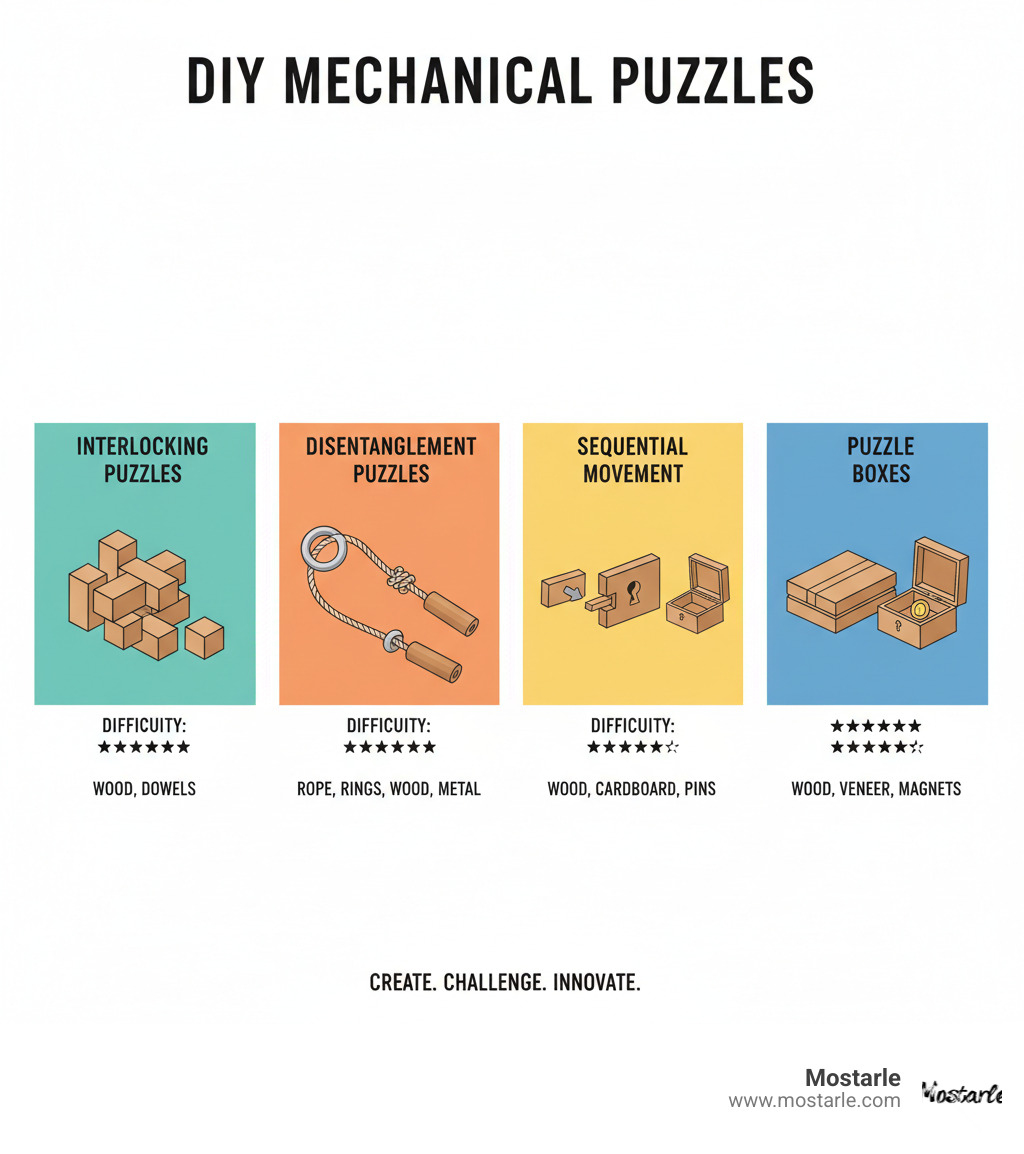
- Interlocking Puzzles - Burr puzzles, soma cubes, and wooden block assemblies
- Dismess Puzzles - Ring and rope puzzles that challenge spatial thinking
- Sequential Movement - Multi-step puzzle boxes with hidden mechanisms
- Materials Needed - Basic wood, dowels, rope, cardboard, and simple tools
- Skill Level - Start with paper crafts, progress to woodworking projects
With the global puzzle market projected to reach $21.1 billion by 2027, DIY puzzle-making has surged in popularity. Makers find deep satisfaction in creating something both beautiful and challenging. As one shared about a keychain puzzle: "I looked at it and thought with only 7 pieces, this should be a breeze"—only to find that the simplest-looking puzzles can hold the greatest surprises.
Building your own puzzles transforms you from solver to creator. You'll learn principles like interference fits, sequential locking mechanisms, and misdirection techniques while developing skills in woodworking, design, and precision crafting.
The beauty lies in the process. Each project teaches patience, problem-solving, and the joy of creating something unique with your own hands.
Getting Started: Your Toolkit and Materials
You don't need a fancy workshop to create amazing diy mechanical puzzles. The right mindset and a few essential tools are all that matter. This spirit of change aligns with our philosophy at Mostarle, where we believe in changing ordinary fragments into remarkable, creative pieces. A simple wooden dowel can become a locking mechanism, and cardboard scraps can form intricate gear systems.

Essential Woodworking Tools
- Hand Saw or Miter Saw: Cuts wood pieces to size. A miter saw offers more precision, but a hand saw with a miter box is also effective.
- Drill or Drill Press: Creates holes for dowels, ropes, and internal mechanisms. A drill press provides superior accuracy for perpendicular holes, which is often critical, as seen in the "Free the Bee Puzzle."
- Clamps: Essential for holding pieces securely while glue dries or during drilling and cutting, preventing frustrating slips.
- Sandpaper or a Sander: Ensures moving parts glide effortlessly and creates a professional, safe-to-handle finish.
- Rulers and Pencils: Provide the clear markings and exact measurements that form the foundation of every successful puzzle.
- Wood Glue: Creates strong bonds, while carpenter's glue or hot glue works well for paper and cardboard.
- Other Tools: Depending on the project, a soldering iron (for melting plastic) or a router (for chamfering edges like in the "Dowel Lock Puzzle") can be useful.
Choosing and Sourcing Your Materials
The magic of diy mechanical puzzles is in changing a variety of materials into masterpieces.
- Plywood: 3mm or 1/4 inch thickness is a stable, workable backbone for many projects, from the "Free the Bee Puzzle" to the "Wooden Programmable Puzzle Box."
- Scrap Hardwood: Woods like maple or mahogany add beauty and durability. Offcuts can become stunning components, like the laminated pieces in the "Dowel Lock Puzzle."
- Wooden Dowels: Indispensable as pins, axles, or key components in puzzles like the "Wooden Block and Pin Puzzle."
- Cardboard: A surprisingly robust and versatile material, perfect for prototyping or creating finished pieces like the "Cardboard Steampunk Puzzle Box." Layering and gluing it can create intricate gears and locks.
- Rope and String: Essential for dismess puzzles, with the type depending on your design.
- Recycled Materials: PVC pipes, nuts, bolts, and bottle caps offer endless possibilities. The "Mechanical Puzzle Box" cleverly uses PVC for its lock. For more inspiration, check out the Toys from Trash initiative.
Prioritize safety: always wear eye protection when cutting or drilling, work in a well-ventilated area, and respect sharp tools. With these basics, you're ready to create.
Understanding the Mechanics: Core Puzzle Principles
Every great diy mechanical puzzle has a secret—a clever mechanical principle or a psychological trick. Understanding these core concepts is like learning the language of puzzles, allowing you to both solve and create them. They are masters of misdirection, often leading to that incredible "Aha!" moment when the solution clicks.
For a deeper dive into these principles, our comprehensive guide covers everything: More info about mechanical puzzles.
Interlocking and Assembly Puzzles
These puzzles challenge your 3D thinking by asking you to assemble scattered pieces or disassemble a solid-looking object.
- Burr puzzles are classic examples, featuring notched wooden sticks that lock together and require a specific sequence of moves to solve.
- Soma cubes use seven unique polycube pieces to form a 3x3x3 cube, training you to visualize how odd shapes work together.
- Pin-and-block puzzles, like the seven-piece "Wooden Block and Pin Puzzle," use a central block and pins to lock everything together, often appearing simpler than they are.
The key is interference fit: a careful balance of tight and loose tolerances. Some holes are snug for a secure connection, while others are larger to allow movement. Getting this right is crucial—too tight and pieces won't move; too loose and the puzzle falls apart. Want to build one? This guide walks you through it: Wooden Block and Pin Puzzle guide.
Dismess Puzzles
Dismess puzzles challenge you to separate seemingly linked items like rings and ropes. Brute force is useless; they reward patience, observation, and an understanding of topology concepts.
- Rope and ring puzzles, like the "Lollipop Puzzle" or "Dumb-bell Puzzle," are the heart of this category. The "Free the Bee Puzzle" adds a fun twist with a wooden bee.
- More complex versions like the "Turtles Puzzle" are masters of misdirection, hiding the solution in an unexpected twist. The moment of findy is pure magic. For a detailed free resource on rope arrangements, see this Free PDF for a rope puzzle.
Sequential Movement and Puzzle Boxes
Sequential movement puzzles and puzzle boxes are sophisticated mechanical stories that unfold step-by-step, revealing secrets through sliding mechanisms, hidden compartments, and ingenious cams and levers.
- Sliding mechanisms are the backbone, with panels gliding in specific sequences to open up the next step.
- The thrill comes from finding hidden compartments and seeing complex internal movements triggered by cams and levers.
- Programmable locks, like in the "Wooden Programmable Puzzle Box," let you set your own combinations, creating a "reverse escape room" experience.
- Mechanical puzzle boxes are the pinnacle, requiring a specific sequence of actions to open. The "Mechanical Puzzle Box" tutorial shows a two-step process with rotating PVC circles and a decoy lid. Even a "Cardboard Steampunk Puzzle Box" teaches about gears and lock mechanisms. Ready to build your own? Try this tutorial: Mechanical Puzzle Box tutorial.
Your First DIY Mechanical Puzzles: Beginner Projects
Ready to start making diy mechanical puzzles? You don't need extensive experience or expensive tools. These beginner projects build confidence and provide the satisfaction of creating something challenging with your own hands. As we at Mostarle know, remarkable things can spring from basic materials.
The Classic "Free the Ring" Dismess Puzzle
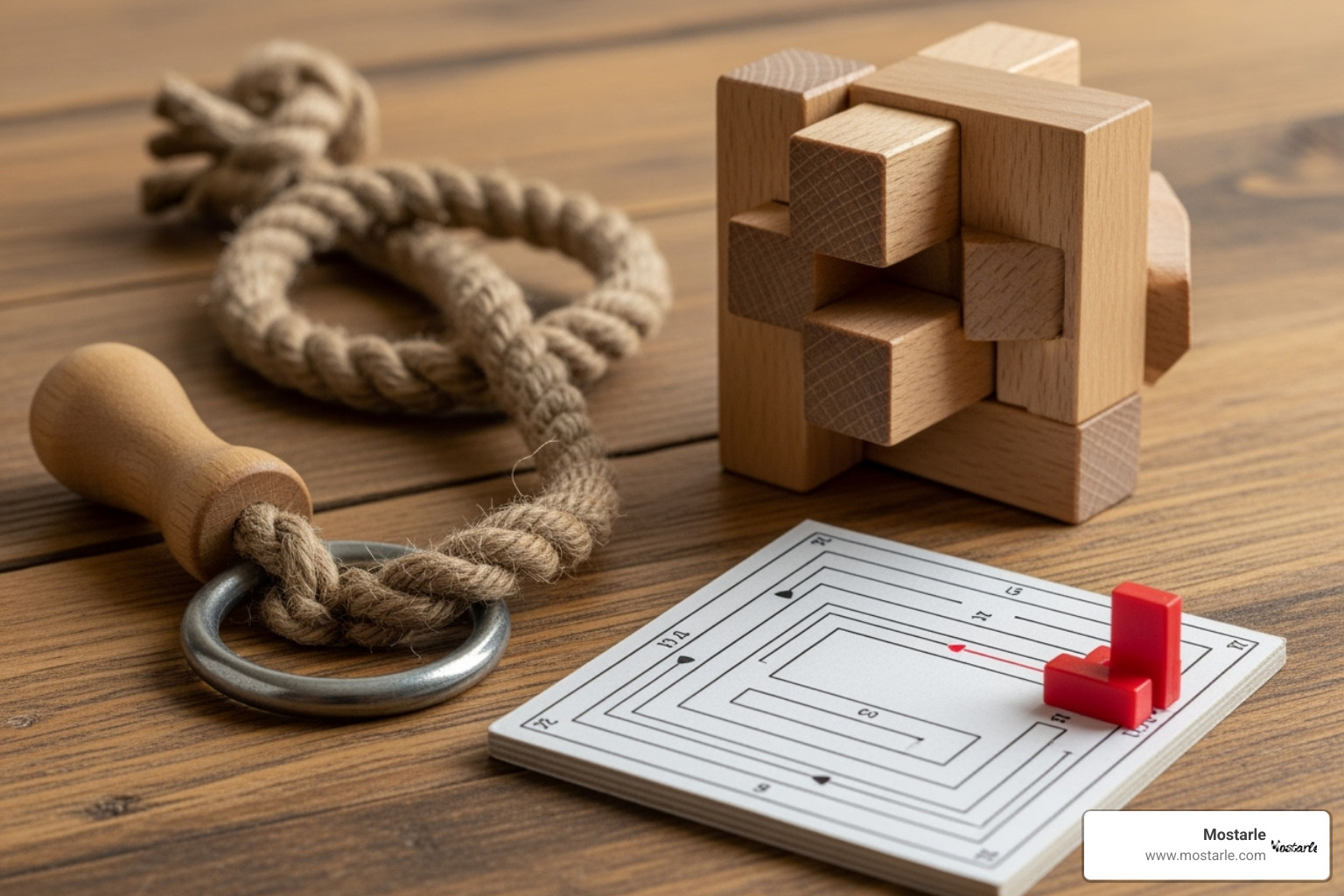
The "Free the Ring" puzzle is a classic dismess puzzle that looks simple but can be deceptively tricky, making it a perfect introduction to misdirection.
- Simple Design: It features a ring trapped on a wooden rod connecting two shapes, as seen in the "Lollipop Puzzle" or "Dumb-bell Puzzle."
- Common Materials: You'll need a wooden dowel, a ring, and string. The "Free the Bee Puzzle" uses wooden bee spoons for a whimsical touch.
- Basic Skills: You'll learn basic drilling and finishing. For instance, the "Free the Bee Puzzle" requires drilling precise 3mm holes. Start with a simpler project like the "Tree Hole Puzzle" if you're new to this.
For step-by-step guidance, check out this Dumb-bell puzzle inspiration.
Building a Simple Wooden Soma Cube
The Soma Cube is a challenging geometric puzzle that teaches fundamental woodworking skills. It consists of seven unique pieces (polycubes) that assemble into a 3x3x3 cube.
- Cutting Accuracy: This is key; a miter saw helps create the clean, consistent cuts needed for the pieces to fit.
- Sanding for a Perfect Fit: This is essential for smooth interlocking and gives the puzzle a wonderful tactile feel.
- Geometric Challenge: The Soma Cube helps develop spatial reasoning. As explored in The healing power of puzzles, these activities engage our minds in ways that promote cognitive growth.
Crafting your first diy mechanical puzzles from Paper or Cardboard
Paper and cardboard are versatile materials for creating surprisingly sophisticated diy mechanical puzzles. They're also perfect for prototyping ideas before using wood.
- Print-and-Play Designs: Projects like "Pattern Match Puzzles" use heavy paper and cardboard backing, with many free templates available online.
- Low-Cost Materials: These allow you to experiment fearlessly with just paper, cardboard, glue, and a craft knife.
- Cutting and Gluing Techniques: You can learn advanced techniques. The "Cardboard Steampunk Puzzle Box" is a great example, using layered cardboard strips to create functional gears and locks. You can follow the complete build process in this detailed Cardboard Steampunk Puzzle Box project.
Level Up: Designing and Building Complex DIY Mechanical Puzzles
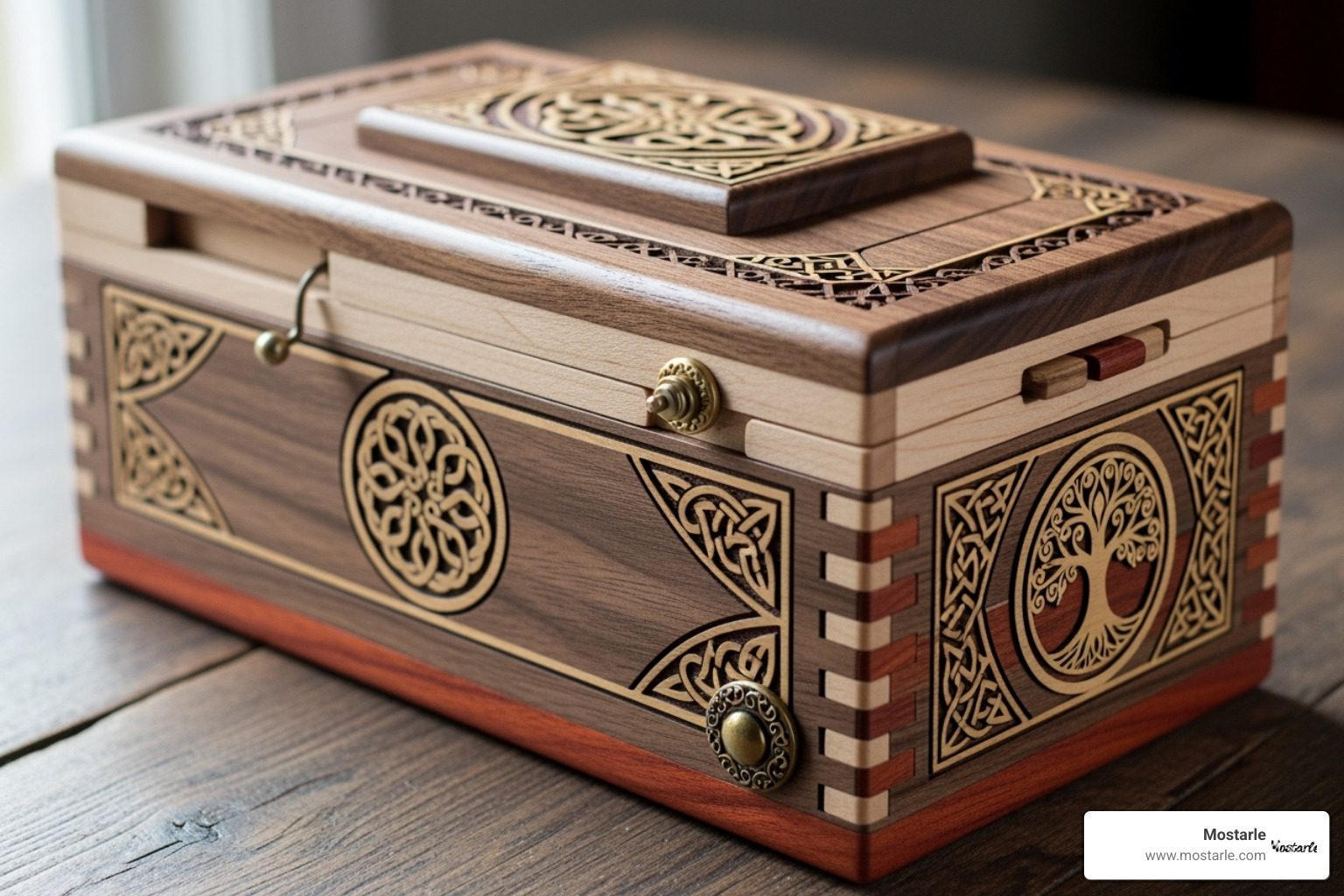
Once you've mastered the basics, you can tackle more ambitious diy mechanical puzzles. This is where your creativity takes flight. Crafting a complex, multi-stage puzzle box is immensely satisfying, turning ordinary components into functional art.
The Design Process: From Idea to Blueprint
Moving to complex projects requires a thoughtful design process.
- Brainstorming concepts: Start with a core idea. What should the puzzle do? How many steps should the solution have?
- Sketching mechanisms: Draw your ideas on paper to map out how pieces will move and interact. These are functional blueprints.
- Prototyping with cheap materials: Build a test version with cardboard or foam board to test mechanisms and refine your design before using expensive wood.
- Iterative design: Be prepared to build, test, find flaws, and refine. The "Wooden Programmable Puzzle Box" reached version 2.2, showing how even experts iterate.
For inspiration, look to masters like Japanese puzzle designer Yukio Hirose: Find inspiration from puzzle designers like Yukio Hirose.
Advanced Techniques for complex diy mechanical puzzles
These techniques add layers of complexity and intrigue to your creations.
- Creating multi-step puzzle boxes: Design interlocking mechanisms that must be solved in a specific order. The "Wooden Programmable Puzzle Box" is a great example, acting as a "reverse escape room" with sequentially locked trays.
- Incorporating magnets: Use magnets for subtle locking mechanisms and misdirection. The "Dowel Lock Puzzle" uses magnets to hold steel balls in place, requiring a sharp tap to dislodge them: Dowel Lock Puzzle with magnets.
- Designing decoy mechanisms: Misdirection is an art. The "Dowel Lock Puzzle" includes a misleading rolling ball to distract solvers from the true solution.
- Building programmable locks: These mechanical combination locks allow you to set and reset solutions for endless replayability, as seen in the "Wooden Programmable Puzzle Box."
The Challenges and Rewards of Puzzle Crafting
Building complex puzzles demands dedication, but the reward is extraordinary.
- Patience and precision are essential. Every measurement matters, as even minor inaccuracies can ruin a puzzle's function.
- Overcoming building challenges is part of the process. Persistence pays off as you test, tweak, and redesign.
- The satisfaction of a working mechanism is pure magic—tangible proof of your ingenuity.
- You're creating a unique, functional art piece that lives at the intersection of art and engineering. This aligns with our philosophy at Mostarle of changing ordinary fragments into remarkable pieces. This journey explores the difficulty for both maker and solver: How difficult are 3D mechanical puzzles?.
Frequently Asked Questions about DIY Puzzle Making
Building diy mechanical puzzles opens up a world of creativity, but it's natural to have questions. Here are answers to common concerns.
What are the educational benefits of building mechanical puzzles?
Building diy mechanical puzzles offers significant educational benefits. You'll develop crucial STEM skills, including spatial reasoning (visualizing how 3D pieces fit together) and problem-solving (troubleshooting mechanisms). You also gain a hands-on understanding of engineering principles like gears and locks. The process cultivates fine motor skills, patience, and attention to detail—essential life skills.
How can I make my wooden puzzles last longer?
To make your wooden puzzles last, choose durable hardwoods like maple or oak. Properly sand all pieces to reduce friction and wear. Apply a protective finish like mineral oil, wax, or polyurethane for durability. Finally, store your puzzles in a stable environment away from extreme humidity or temperature to prevent warping.
Where can I find more plans and ideas for puzzles?
The puzzle-making community is generous with plans and ideas. Here are some great resources:
- Instructables is a goldmine of step-by-step guides for all skill levels.
- Woodworking forums and online communities are great for connecting with experienced makers for help and inspiration.
- Individual puzzle designer blogs, like Yukio Hirose's site, showcase beautiful creations that can spark ideas.
- For deeper learning, explore books on puzzle design. We've curated a list of our favorites: Top 10 books about mechanical puzzles worth reading.
Remember the Mostarle mindset: inspiration is everywhere, and creativity has no limits.
Conclusion
Creating diy mechanical puzzles is more than a hobby—it's a pathway to personal growth, from understanding simple mechanisms to designing intricate puzzle boxes. Every project, from a first cardboard creation to a complex hardwood masterpiece, represents thoughtful design, patient craftsmanship, and creative problem-solving.
The beauty of this craft is in the process. You develop precision, patience, and resilience. Most importantly, you experience the joy of changing ordinary materials into something extraordinary with your own hands.
At Mostarle, we believe that creativity has no limits, and your puzzle-making journey proves this. Just as we transform forgotten nuts and bolts into remarkable art, you're taking simple wood, rope, and cardboard and breathing life into them—creating brain-teasing treasures.
Whether you love the meditative process of sanding wood, the intellectual challenge of design, or the satisfaction of stumping a friend, you've joined a community of makers who understand that the best puzzles come from the heart.
Your creative potential is limitless. Every scrap of wood and every cardboard box is a new puzzle adventure waiting to happen. Keep your tools handy, let your imagination run wild, and continue your journey.
Ready to dive even deeper? Learn everything you need to know about mechanical puzzles and continue expanding your creative horizons.