Expert Support

Curated Collection: Black Metal Sculptures for Every Style
Why Black Metal Sculpture Captivates Art Collectors and Design Enthusiasts
Black metal sculpture has become one of the most sought-after forms of contemporary art, changing spaces with its bold presence and timeless sophistication. Whether you're searching for a statement piece for your living room or an outdoor installation that commands attention, black metal sculptures offer best versatility across every aesthetic.
Top Black Metal Sculpture Styles to Consider:
- Abstract & Geometric - Clean lines and minimalist forms for modern interiors
- Nature-Inspired - Animal silhouettes, trees, and botanical designs
- Industrial & Upcycled - Recycled materials with raw, authentic character
- Figurative Works - Human forms and cultural representations
- Monumental Pieces - Large-scale installations for dramatic impact
The appeal of black metal sculpture extends far beyond simple decoration. As artist El Anatsui noted about his transformative work with metal, "I look for things that are immediately available... I transform the media; I give them a new lease on life."
This philosophy captures the essence of what makes black metal sculpture so compelling. The color black adds visual weight and emotional resonance to any piece. It creates dramatic interplay between shadow and light, accentuates form, and defines silhouettes with striking clarity.
From Alexander Calder's monumental "Black Beast" created in 1940 to contemporary recycled metal art that prevents waste from entering landfills, black metal sculpture has evolved into a diverse art form. The global metal sculpture market, valued at $1.7 billion in 2022, continues to grow as collectors and homeowners find pieces that speak to their unique creative vision.
The beauty of black metal lies in its ability to complement any style—whether you're drawn to sleek modernism, rustic nature themes, or bold industrial aesthetics.
The Allure of Black: Why This Color Dominates in Metal Art
There's something undeniably captivating about the color black, especially when it's rendered in metal. It's not just a color; it's a statement. In the field of sculpture, black brings a unique set of characteristics that lift a piece from mere object to a profound artistic expression.
Black imparts a significant visual weight, giving sculptures a grounded, powerful presence. It suggests sophistication and timelessness, allowing the artwork to blend seamlessly into diverse environments while still commanding attention. Think of a sleek, dark silhouette against a brightly lit wall, or a monumental installation standing starkly against a natural landscape. The emotional resonance of black is profound, often evoking feelings of mystery, power, and elegance. It has the remarkable ability to absorb light, creating dramatic shadows and accentuating the inherent form and contours of the metal. This interplay of shadow and light can make a piece feel dynamic and alive, constantly shifting with the viewer's perspective and ambient lighting.
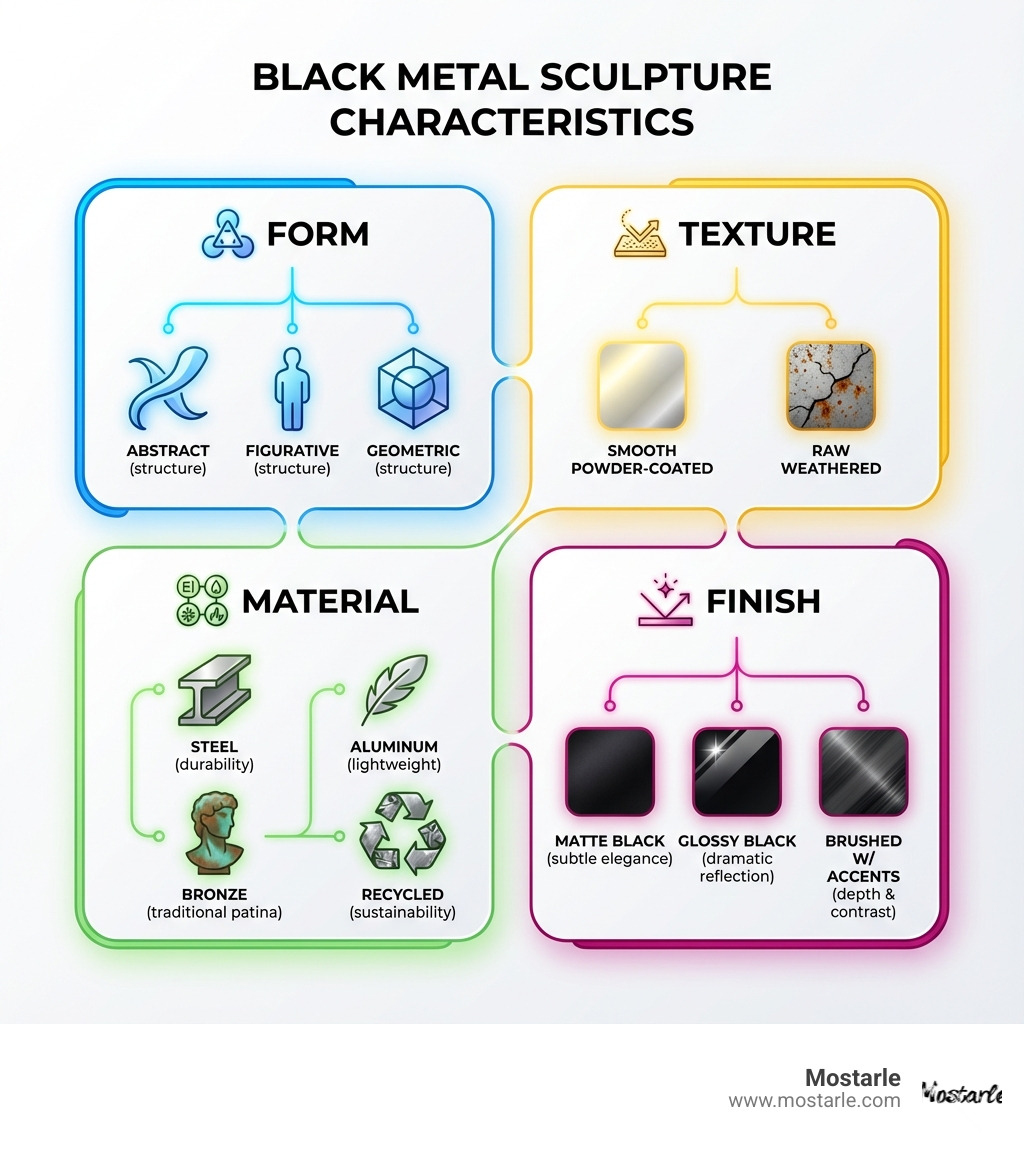
The use of black also sharpens the definition of a sculpture's silhouette. Without the distraction of color or intricate surface patterns, the viewer's eye is drawn directly to the lines and shapes, appreciating the pure form the artist intended. This is particularly effective in minimalist or abstract black metal sculpture, where the form itself is the primary subject. Whether it's a matte finish that absorbs light for a subtle, understated elegance, or a glossy black that reflects its surroundings, the choice of finish further improves this visual impact.
As we explore further, you'll see how this powerful aesthetic choice transforms ordinary metal into extraordinary art. We believe that black metal sculpture offers unique possibilities for those looking to add depth and character to their spaces. For more inspiration on how to integrate unique metal art into your home, we invite you to explore our insights on Beyond the ordinary: Unique metal art and decor for your living space.

A Journey Through Time: The Evolution of Metal Sculpture
The story of metal sculpture is as old as civilization itself, evolving from ancient craft to modern art. Early forms of metalwork, often in bronze, served practical, religious, and decorative purposes. While not always "black" in the contemporary sense, many ancient metal pieces developed dark patinas over centuries, giving them a somber, powerful aesthetic. For instance, the fierce 11th-century 'The Buddhist Guardian Mahabala' from Java, Indonesia, now housed at The Metropolitan Museum of Art, is a bronze figure that, through time and perhaps intentional darkening, conveys a formidable presence. Though its primary classification is bronze, its deep, aged tones certainly contribute to a dark, imposing visual weight.
The 20th century marked a dramatic shift, as artists began to explore metal not just for its strength but for its expressive potential. Modernism acceptd industrial materials and techniques, leading to a surge in metal sculpture. Artists like Alexander Calder, renowned for his mobiles and stabiles, made groundbreaking use of sheet metal. His 1940 monumental work, 'Black Beast', crafted from sheet metal, bolts, and paint, stands as a testament to the power of black in large-scale sculpture. It's an abstract, stationary form that uses its dark hue to define its imposing presence and striking silhouette.
Similarly, Isamu Noguchi, another pioneer of modern sculpture, created the iconic 'Black Sun' between 1960 and 1963, later cast in 1967. This powerful piece, held by the Smithsonian Institution, exemplifies how a simple, dark form can evoke cosmic grandeur and contemplation. These artists laid the groundwork for future generations, demonstrating that metal, especially when rendered in black, could convey profound artistic statements.
From these modernist roots, black metal sculpture continued to diversify, incorporating abstract expressionism, minimalist aesthetics, and eventually, the repurposing of industrial and found objects. Today, we see a rich mix of styles and approaches, all building on a legacy of innovation and the timeless appeal of metal.
Exploring Styles and Themes in Black Metal Sculpture
The beauty of black metal sculpture lies in its incredible versatility. Artists harness the material's strength and the color's dramatic impact to explore a vast array of styles and themes. From the stark simplicity of abstract forms to the intricate details of nature-inspired pieces, there's a black metal sculpture for every taste and setting.
Abstract and Geometric Forms
For those who appreciate clean lines, modern aesthetics, and intellectual engagement, abstract and geometric black metal sculpture offers endless possibilities. These pieces often feature sharp angles, sweeping curves, and minimalist compositions that play with space and perception. The absence of literal representation allows the viewer to interpret the form, texture, and light interaction in a personal way.
Artists use black to emphasize the purity of these shapes, creating bold statements that can serve as architectural elements in a contemporary home or office. We find that these sculptures are particularly effective in creating a focal point without overwhelming a space, offering a sophisticated touch. Our expertise in Crafting your aesthetic: Custom metal art sculptures for every style often involves working with clients to design these types of pieces, ensuring they perfectly complement their unique vision.
Nature-Inspired Black Metal Sculpture
Nature has always been a wellspring of artistic inspiration, and black metal sculpture offers a powerful medium for capturing its essence. We see a strong trend in pieces depicting animal silhouettes, from the graceful flight of birds to the majestic presence of forest creatures. Trees and botanical designs, often rendered as intricate wall hangings or standing pieces, bring the tranquility of the outdoors inside. A black metal tree sculpture, for example, can beautifully capture the silhouette of a spruce tree, changing a natural icon into a striking piece of wall decor. These sculptures often feature organic shapes that convey movement and life, making them perfect for garden art or to add a rustic yet refined touch to interior spaces. The matte black finish often used in these pieces allows the natural form to shine, creating a subtle elegance that resonates with our love for the natural world.
Industrial and Upcycled Black Metal Sculpture
Perhaps one of the most exciting and conscientious trends in black metal sculpture is the use of industrial and upcycled materials. This style champions sustainability, changing discarded fragments into remarkable works of art. At Mostarle, this philosophy is at the core of what we do: taking ordinary, forgotten fragments like nuts and bolts and giving them a new lease on life as creative, unique pieces.
Artists in this field often work with scrap metal, old tools, and various found objects, welding and reshaping them into intricate sculptures. The inherent textures and histories of these materials add layers of character that cannot be replicated with new metal. This approach aligns perfectly with the idea of "art with a conscience," as it not only creates beauty but also contributes to reducing waste. The movement is gaining significant traction, with growing consumer interest in metal art made from recycled and repurposed materials.
Consider the impactful work of artists like El Anatsui, whose 'Black Block' sculpture uses flattened aluminum caps from thousands of bottles, wire-stitched into massive, textile-like tapestries. His approach demonstrates how humble, discarded materials can be transformed into monumental art, each piece carrying the "human touch" and history of its previous life. This emphasis on the spiritual energy and narrative embedded in everyday objects showcases the transformative power of upcycled art. An Argentine teacher, for instance, gained over 350k social media followers by turning junk into educational treasures, inspiring students and demonstrating this very principle.
This industrial chic aesthetic offers a raw, authentic character that appeals to those who appreciate the beauty in imperfection and the story behind each component. If you're looking for truly unique pieces that blend artistry with environmental responsibility, we encourage you to explore our insights on From industrial chic to artisan: Unique, discovering the best handmade gifts and Art with a conscience: Exploring sustainable practices in the art world.
From Raw Material to Masterpiece: Crafting Techniques
The journey from a raw piece of metal to a captivating black metal sculpture is a fascinating display of skill, precision, and artistic vision. The choice of material and the techniques employed are crucial in defining the final aesthetic, durability, and character of the artwork.
Commonly used metals in sculpture include:
- Steel: Highly durable and versatile, steel is a favorite for its strength and ability to be shaped. It can be welded, cut, and forged into complex forms.
- Iron: Known for its robustness and rustic appeal, cast iron has been used for centuries. Wrought iron, often used in decorative scrollwork, offers classic elegance.
- Aluminum: Lighter than steel, aluminum is ideal for larger sculptures where weight is a concern. It's corrosion-resistant and can be easily manipulated.
- Bronze: A traditional sculptural material, bronze offers excellent durability and takes on beautiful patinas over time. While not inherently black, it can be chemically treated to achieve dark finishes.
Here's a comparison of some common metals:
| Metal | Durability | Weight | Cost | Finish |
|---|---|---|---|---|
| Steel | High | Medium-Heavy | Medium | Can be polished, painted, powder-coated |
| Aluminum | High | Light | Medium-High | Polished, anodized, painted, powder-coated |
| Bronze | Very High | Heavy | High | Develops natural patina, can be chemically treated |
Once the metal is chosen, artists employ various techniques to bring their visions to life:
- Welding: This is a primary method for joining metal pieces together, allowing for the creation of complex, multi-component sculptures. It's a foundational skill for many metal artists, enabling them to build up forms and structures. We often highlight the transformative power of this technique in our blog, Welding wonders: Unleash your inner metal artist.
- Forging: Involves heating and hammering metal to shape it, a traditional method that imparts a unique, handcrafted quality.
- Casting: Liquid metal is poured into a mold, capturing intricate details. This is common for bronze and iron sculptures.
- Laser Cutting: Modern technology allows for incredibly precise cuts and intricate designs, perfect for creating detailed silhouettes and layered pieces. This technique is often used for creating the sharp, clean lines seen in many abstract and nature-inspired black metal sculpture designs.
After shaping, the finishing process is critical, especially for achieving the desired black aesthetic:
- Powder Coating: A durable, protective finish where dry powder is electrostatically applied and then cured under heat. It provides an even, hard surface and is excellent for outdoor sculptures.
- Patination: Chemical treatments can be applied to bronze and other metals to create a darkened, aged appearance.
- Painting: Traditional liquid paint can be used, offering a wide range of black shades and finishes, from matte to glossy.
The choice of finish significantly impacts the sculpture's appearance and longevity. A matte black finish, for instance, provides a subtle elegance, while a glossy black can create dramatic reflections. Combining brushed steel with powder-coated black elements can add depth and contrast, as seen in many Canadian metal art pieces.
How does black metal sculpture differ from other forms of metal art? While all metal art uses similar materials and techniques, black metal sculpture specifically leverages the aesthetic power of the color black. This choice often emphasizes form, silhouette, and the interplay of light and shadow, distinguishing it from colorful, polished, or un-finished metal works. It's about using a singular, powerful hue to make a profound artistic statement.
Frequently Asked Questions about Black Metal Sculptures
We often hear many questions from enthusiasts and collectors about these striking pieces. Here are some of the most common inquiries, along with our expert answers.
How do I care for my black metal sculpture?
Caring for your black metal sculpture ensures its beauty and longevity, whether it's an indoor accent or a grand outdoor installation.
- Indoor Care: For indoor sculptures, regular dusting with a soft, dry cloth is usually sufficient. Avoid abrasive cleaners, which can scratch the finish. If a deeper clean is needed, a slightly damp cloth with mild soap can be used, followed by thorough drying.
- Outdoor Care: Outdoor sculptures are exposed to the elements, so they require a bit more attention. Weathering is a natural process for metal, but you can minimize its effects. We recommend an annual or as-required maintenance schedule. This might involve cleaning off dirt and debris with water and a soft brush, then applying a protective clear coat designed for outdoor metal. For pieces with a powder-coated finish, this layer helps maintain its integrity.
- Preventing Rust: If your sculpture is made of steel or iron and not adequately protected, rust can be a concern. Ensure any protective coatings are intact. If rust spots appear, they can often be gently sanded away and touched up with a suitable metal paint or rust-inhibiting primer, followed by a black topcoat.
- Stability and Security: For larger outdoor sculptures, proper installation is paramount. They must be adequately secured, either through ground anchoring or by being set on a concrete pad, to ensure they remain stable and safe, especially in windy conditions.
What's the difference between powder coating and painting?
Both powder coating and painting apply a finish to metal, but they differ significantly in their composition, application, and performance.
-
Composition:
- Painting uses liquid paint, which contains a resin, pigment, solvent, and additives. The solvent evaporates as the paint dries.
- Powder coating involves a dry powder, typically a thermoplastic or thermoset polymer, mixed with pigments and other additives. It contains no solvents.
-
Application Process:
- Painting is applied as a liquid, often sprayed or brushed, and air-dries or is oven-cured.
- Powder coating is electrostatically applied to the metal. The charged powder particles adhere to the electrically grounded metal surface. The piece is then heated (cured) in an oven, which melts the powder into a smooth, even film that chemically bonds to the metal.
- Durability: Powder coating generally offers superior durability. It's much more resistant to chipping, scratching, fading, and corrosion than liquid paint. This makes it an excellent choice for outdoor black metal sculpture or pieces in high-traffic areas.
- Finish Quality: Powder coating typically results in a thicker, more uniform, and often more attractive finish with fewer runs or drips compared to liquid paint. It can also achieve a wider range of textures.
- Environmental Impact: Powder coating is often considered more environmentally friendly because it releases minimal volatile organic compounds (VOCs) into the atmosphere, as it contains no solvents. Unused powder can also be recycled.
- Cost: While the initial setup for powder coating can be more expensive, its superior durability often translates to lower long-term maintenance costs.
For a black metal sculpture, powder coating provides a robust, sleek, and long-lasting black finish that can withstand the test of time and weather, making it a popular choice for both artists and collectors.
Where can I find unique black metal sculptures?
The quest for the perfect black metal sculpture can lead you to a variety of exciting places, both physical and digital. The market for metal art is diverse, featuring contributions from both established artists and emerging creators.
- Art Galleries: High-end art galleries, especially those specializing in contemporary or modern art, are excellent places to find unique black metal sculptures. Institutions like The Noguchi Museum, the Smithsonian Institution, The Metropolitan Museum of Art, and the Brooklyn Museum often feature significant historical and contemporary examples in their collections or special exhibitions.
- Artist Studios: Many artists work directly from their studios and welcome visitors by appointment. This allows for a personal connection with the creator and the opportunity to see works in progress. This direct-from-artist approach is a great way to find unique, hand-crafted pieces.
- Online Marketplaces: The digital field offers an expansive selection. Many online platforms and artist-run websites showcase a wide range of metal sculptures available for purchase online, indicating a strong consumer interest in metal-based art. You can find everything from abstract large metal sculptures to contemporary welded artworks.
- Public Art Installations: Keep an eye out in public spaces, parks, and urban centers. Many cities around the world, including those in our operating countries like the Atomium in Belgium, the 'Holy Diver' sculpture in Kavarna, Bulgaria, or even specialized venues like the Bahrain International Motor Track which features black wall art, host impressive examples of large-scale metal sculptures. These provide an opportunity to experience the art in its intended environment.
- Commissioning Custom Work: If you have a specific vision, many artists and artisan workshops specialize in custom metalwork. This allows you to collaborate directly with a creator to bring your unique idea for a black metal sculpture to life, custom to your space and aesthetic preferences. At Mostarle, we pride ourselves on crafting unique pieces, and custom commissions are a wonderful way to achieve something truly personal.
The demand for handcrafted and unique metal art pieces is evident, and with so many avenues to explore, finding your perfect black metal sculpture is an exciting journey.
Conclusion
The world of black metal sculpture is as rich and varied as the materials it employs. We've journeyed through its defining characteristics, from its profound visual weight and emotional resonance to the dramatic interplay of light and shadow that makes each piece a statement. We've seen how artists leverage materials like steel, aluminum, and bronze, and transform them through techniques such as welding, laser cutting, and powder coating, to create masterpieces.
From the ancient, dark patinas of historical metalwork to the bold modernism of Calder and Noguchi, and the conscientious upcycling of contemporary artists like El Anatsui, black metal sculpture has continually evolved. It accepts a spectrum of styles, from minimalist abstract forms and intricate nature-inspired designs to the raw, authentic character of industrial and recycled art.
At Mostarle, our philosophy is deeply rooted in this transformative power of metal. We believe that creativity truly has no limits, and that ordinary, forgotten fragments like nuts and bolts can be transformed into remarkable, creative pieces. This dedication to craftsmanship and innovative design ensures that every black metal sculpture we encounter or create tells a unique story, adding depth, character, and sophistication to any space.
Whether you're drawn to the sleek lines of a geometric design, the organic flow of a natural silhouette, or the compelling narrative of an upcycled creation, black metal sculpture offers something for every style. It's more than just decor; it's an investment in art that will endure and inspire for years to come.
We invite you to explore the incredible creative potential that lies within everyday materials. Explore our collection of unique 3D metal art and discover the magic of transformed hardware and find the perfect piece to lift your space.