
Beyond Sudoku: A Guide to Truly Brain-Stimulating Puzzles
Why Your Brain Craves a Good Puzzle
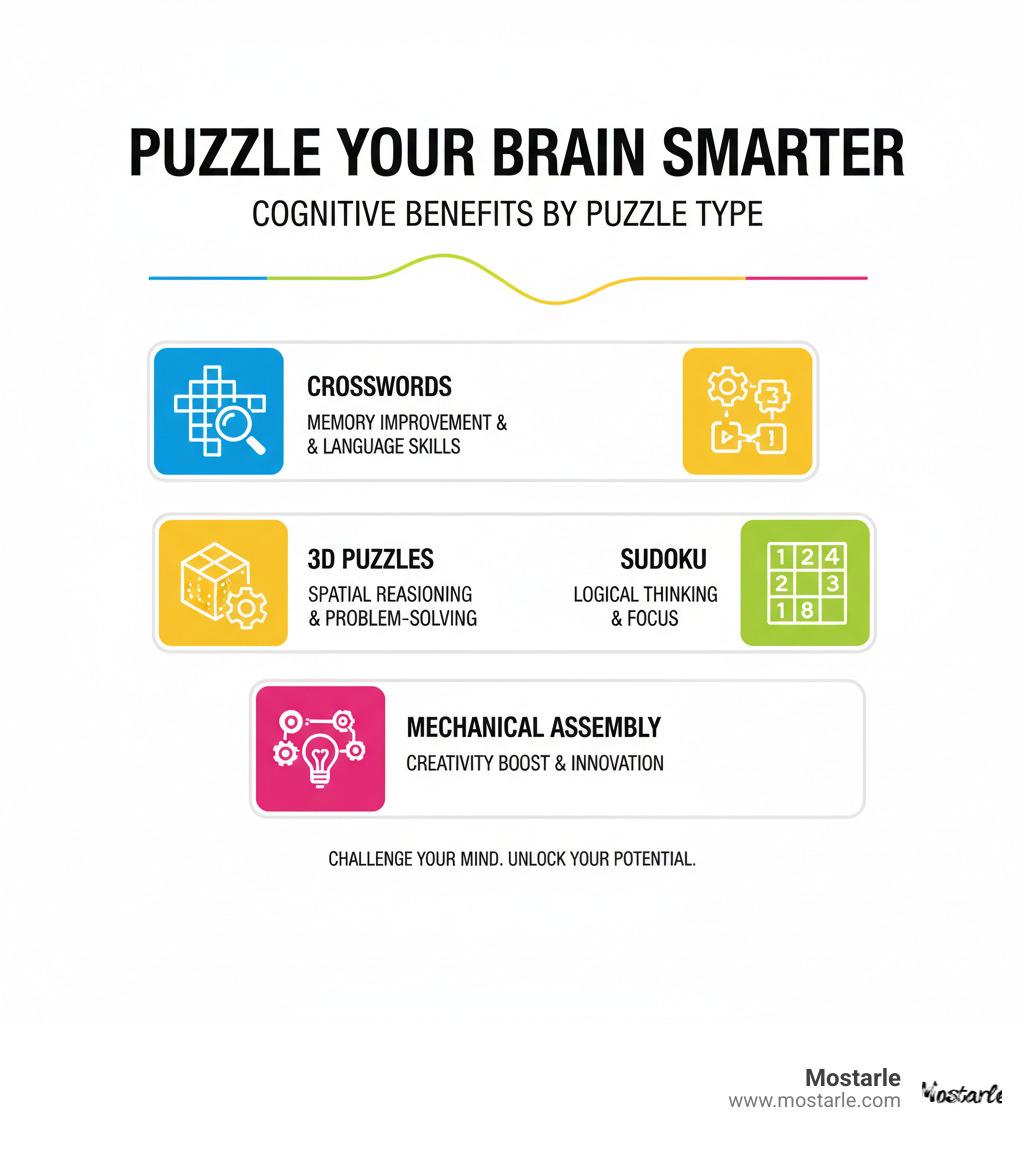
Brain stimulating puzzles offer powerful cognitive benefits that go far beyond simple entertainment. These mental challenges improve memory, improve focus, boost problem-solving skills, and may even reduce the risk of age-related cognitive decline by up to 63% according to research on mental activity scores.
Key Benefits of Brain Stimulating Puzzles:
- Memory Improvement - Crossword puzzles help with knowledge retention (2022 research)
- Cognitive Function - Chess improves brain function and strategic thinking
- Focus & Attention - Sudoku exercises both left and right brain simultaneously
- Neuroplasticity - Critical thinking puzzles rewire your brain for better performance
- Stress Relief - Puzzle-solving releases dopamine and provides relaxation
- Dementia Prevention - Regular mental challenges may delay cognitive decline
Your brain works like a muscle - the more you challenge it, the stronger it becomes. While simple games might provide momentary fun, truly brain stimulating puzzles push your cognitive abilities in ways that create lasting benefits.
Think about that satisfying moment when you crack a tough riddle or fit the final piece into a complex 3D puzzle. That "aha!" feeling isn't just rewarding - it's your brain forming new neural pathways and strengthening existing ones through neuroplasticity.
The key lies in moving beyond basic puzzles toward challenges that engage multiple cognitive skills at once. Logic, creativity, spatial reasoning, and problem-solving all work together when you tackle the right kind of mental workout.
Whether you're looking to sharpen your mind, find a creative outlet, or simply escape the mundane with something uniquely engaging, brain stimulating puzzles offers endless possibilities for growth and findy.
The Science-Backed Benefits of a Puzzling Habit

The moment you pick up a challenging puzzle, something amazing happens in your brain. Scientists have been studying this for years, and what they've found is pretty incredible. Brain stimulating puzzles don't just pass time - they literally change how your mind works.
Think of it like this: every time you solve a Sudoku or work through a complex mechanical puzzle, your brain is getting a serious workout. Research shows that these mental challenges create lasting improvements in cognitive function. Your working memory gets sharper. Your processing speed picks up. Even your problem-solving skills in everyday life get better.
Here's the really cool part - when you're wrestling with a tricky puzzle, both sides of your brain fire up at once. The left side handles the logic and numbers, while the right side works on patterns and creativity. It's like doing a full-body workout, but for your mind.
And remember that satisfying feeling when you finally crack a tough puzzle? That's dopamine flooding your system - the same feel-good chemical that motivates you to keep learning and growing. Your brain literally rewards you for challenging it.
The benefits go way beyond just feeling good, though. Studies have found that people who regularly engage with puzzles show significant improvements in memory and attention spans. Even more exciting, scientific research on chess and cognitive health suggests that these mental workouts might help protect against dementia as we age.
But perhaps the most immediate benefit is stress reduction. When you're focused on fitting puzzle pieces together or working through a logic problem, your mind gets a break from daily worries. It's like meditation, but with the added bonus of accomplishing something concrete.
If you're curious about other ways to give your brain a boost, check out our guide on Boost Your Brain Power: 3 Activities That Activate the Brain.
How Puzzles Rewire Your Brain for Better Performance
Your brain is remarkably adaptable - scientists call this neuroplasticity. Every time you tackle a challenging puzzle, you're actually rewiring your neural pathways. It's like upgrading your brain's software while you're having fun.
When you work on brain stimulating puzzles that demand critical thinking, something fascinating happens. Your mind doesn't just solve that one puzzle - it gets better at approaching all problems. You start seeing patterns more quickly. Your logic becomes sharper. Even your creativity gets a boost as you learn to think outside the box.
Picture what happens when you're working on a complex 3D metal puzzle. You're not just following instructions - you're constantly testing ideas, backing up when something doesn't work, and trying new approaches. Each attempt strengthens the brain cell connections that handle problem-solving.
The best part? These improvements stick around. The problem-solving skills you develop while puzzling transfer to work challenges, family situations, and daily decisions. Your brain becomes more flexible and efficient at tackling whatever life throws your way.
Puzzles and Healthy Aging: A Powerful Connection
Here's some news that might surprise you: regular puzzle-solving could be one of the best investments you make in your future self. Research consistently shows that people who challenge their minds with puzzles experience less age-related cognitive decline.
A particularly encouraging study from 2022 found that crossword enthusiasts showed better knowledge retention and memory compared to their non-puzzling peers. The researchers finded that these word games keep the language centers of the brain active and engaged, helping maintain mental sharpness well into later years.
Research from 2022 on crosswords specifically highlights how these verbal puzzles act like a protective shield for your mind. Regular puzzlers don't just remember more - they process information faster and maintain better focus.
The key is consistency. Just like you wouldn't expect to stay physically fit from one workout, your brain needs regular challenges to stay strong. The good news? Unlike some forms of exercise, puzzles get more enjoyable as you get better at them. Each solved challenge builds confidence and skills for the next one.
Whether you're 25 or 75, it's never too early or too late to start giving your brain the workout it craves. The mental agility you build today could make all the difference in how sharp and engaged you feel tomorrow.
A Universe of Brain Stimulating Puzzles
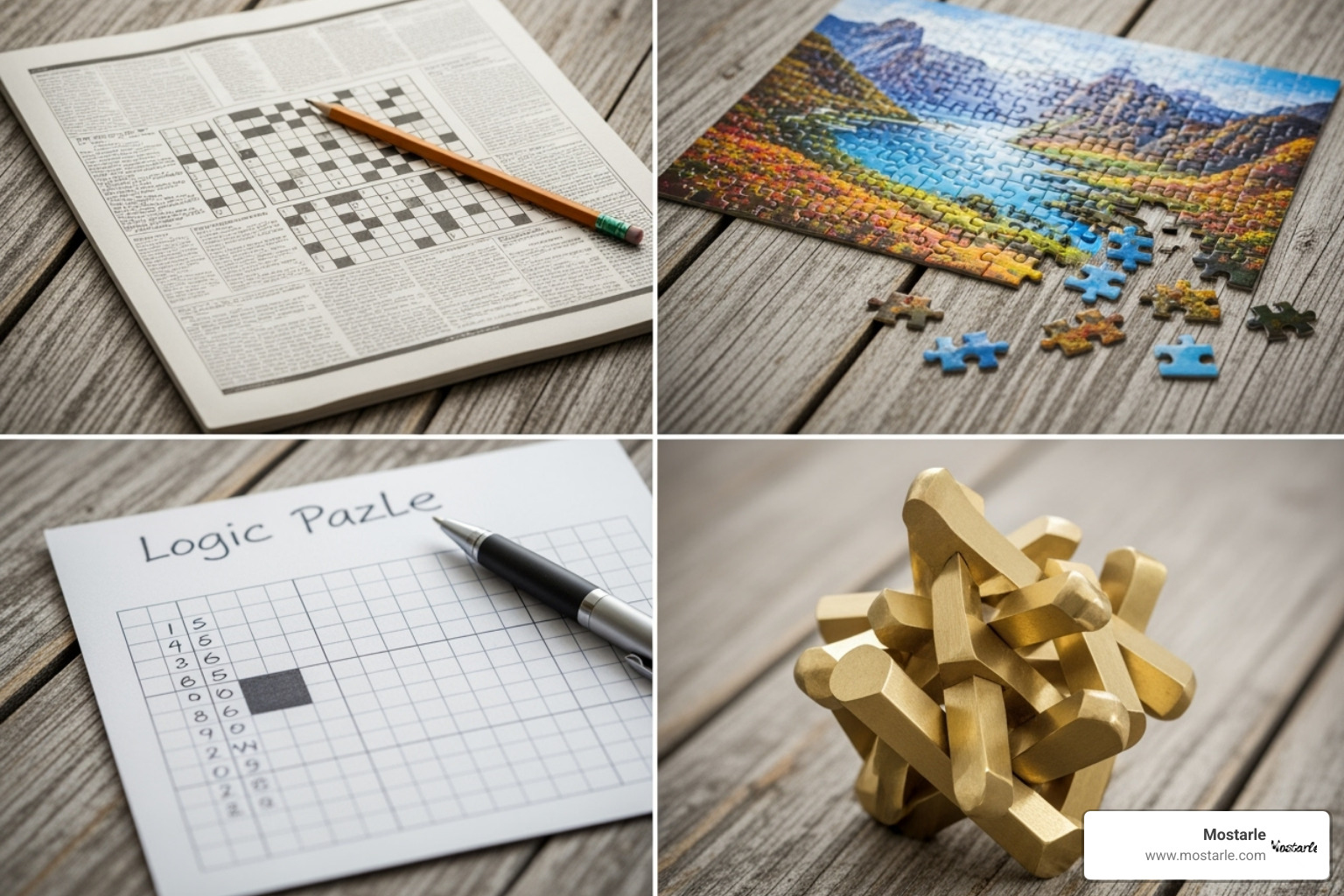
The wonderful thing about brain stimulating puzzles is that there's truly something for everyone. Whether you're a numbers person who loves logical thinking or someone who thinks in pictures and patterns, the puzzle world has endless options waiting for you.
Think of your brain like a toolbox - different puzzles exercise different "tools" in that box. Some puzzles make your analytical side stronger, while others boost your creative thinking. The best part? You don't have to stick to just one type. Mixing different puzzle categories gives your brain the most complete workout possible.
Logic and Number Puzzles for Analytical Minds
If you're the type of person who loves finding patterns and working through problems step by step, logic and number puzzles will feel like coming home. These brain stimulating puzzles are perfect for strengthening your analytical thinking and deductive reasoning skills.
Sudoku stands out as the classic choice here. This number placement puzzle might look simple at first glance, but it's actually giving both sides of your brain a solid workout. You're using logic to figure out which numbers go where, while also recognizing visual patterns across the grid. It's like doing mental gymnastics without breaking a sweat.
Logic grids take this analytical thinking even further. These puzzles give you a scenario with several clues, and you have to work like a detective to figure out the relationships between different elements. They're fantastic for teaching your brain to think systematically and pay attention to details that matter.
Number puzzles beyond Sudoku offer their own unique challenges. From mathematical sequences to calculation-based brain teasers, these puzzles keep your numerical reasoning sharp and your mind quick with calculations.
Word and Language Puzzles to Boost Your Vocabulary
Your way with words says a lot about how your brain works, and word puzzles are one of the most enjoyable ways to keep those language skills sharp. These puzzles don't just expand your vocabulary - they actually strengthen the language centers in your brain.
Crosswords have earned their reputation as brain boosters for good reason. Research shows they genuinely help with knowledge retention, making them more than just a fun way to spend time. When you're working through a crossword, you're pulling information from your memory, making connections between clues, and fitting everything together like pieces of a puzzle.
Word games come in so many varieties that you'll never get bored. Whether you're unscrambling letters, finding hidden words, or building new words from existing ones, these games keep your verbal skills polished and your mind agile. They encourage you to think creatively about language in ways that everyday conversation simply doesn't require.
Visual and Spatial Puzzles for Right-Brain Creativity
For those who think in images and love working with their hands, visual and spatial puzzles offer a completely different kind of mental challenge. These brain stimulating puzzles tap into your creative side while building crucial spatial reasoning skills.
Jigsaw puzzles are probably the most familiar type here, but don't underestimate their power. When you're fitting pieces together, your brain is constantly analyzing shapes, colors, and patterns. You're mentally rotating pieces, predicting how they'll fit, and building a complete picture from fragments. It's spatial reasoning in action.
Spot the difference games might seem simple, but they're actually training your brain to notice subtle details that others might miss. This kind of visual discrimination skill proves useful in countless real-world situations.
Pattern recognition challenges help you understand visual relationships and sequences. Whether you're identifying what comes next in a series or finding the odd one out, these puzzles strengthen your ability to see connections that aren't immediately obvious.
At Mostarle, we understand how powerful visual and spatial challenges can be for cognitive development. Our unique approach to creating models from everyday hardware connects directly to these same skills. You can learn more about this connection in our article on The Connection Between 3D Metal Puzzles and STEM Education.
Mechanical and 3D Puzzles: A Hands-On Mental Workout
Here's where puzzle-solving becomes a full-body experience. Mechanical and 3D puzzles combine intellectual challenge with tactile engagement, giving you a mental workout that you can literally feel in your hands.
3D metal puzzles offer something truly special - they require your brain to work in multiple dimensions at once. You're using hand-eye coordination, logical sequencing, and spatial imagination all together. The process of taking individual metal pieces and changing them into something recognizable mirrors what we do at Mostarle every day.
Assembly kits challenge you to visualize the end result while working with the pieces in front of you. Your brain has to understand how individual components relate to the whole, then figure out the sequence needed to bring everything together. It's problem-solving that engages both your analytical and creative thinking.
At Mostarle, our philosophy centers on changing ordinary, forgotten fragments into remarkable, creative pieces. This process proves that creativity truly has no limits - much like how mechanical puzzles take simple components and create something amazing. The therapeutic benefits of working with your hands while challenging your mind are well-documented too. You can explore more about The Healing Power of Mechanical Puzzles and find how these tactile challenges can both soothe and sharpen your mind.
How to Build a Brain-Boosting Puzzle Routine
Creating a sustainable routine with brain stimulating puzzles is like planting a garden for your mind. You don't need to transform your entire life overnight - just small, consistent steps that grow into something beautiful and rewarding.
The magic happens when puzzling becomes as natural as your morning coffee or evening walk. Think of it as giving your brain a daily treat rather than another task to check off your list. When we enjoy what we're doing, our minds stay engaged and eager for more.
Consistency beats intensity every single time. Spending fifteen focused minutes with a puzzle daily will do more for your cognitive health than cramming in hours once a week. Your brain thrives on regular exercise, just like your body does.
The secret ingredient? Making it genuinely fun. If crosswords feel like homework, try a hands-on mechanical puzzle instead. If Sudoku makes your eyes glaze over, perhaps a colorful jigsaw is more your speed. When you find puzzles that spark joy, the routine builds itself.
Social puzzling adds another delightful dimension. Family game nights, puzzle competitions with friends, or even tackling a challenging project together creates memories while strengthening minds. There's something special about sharing that "aha!" moment with someone you care about.
Choosing Your Ideal Brain Stimulating Puzzles
Finding your perfect puzzle match is like finding a new favorite book - it should feel exciting, not overwhelming. The sweet spot lies where challenge meets enjoyment, creating what psychologists call a "flow state."
Your ideal puzzle should make you think without making you want to throw it across the room. Too easy, and your brain gets bored. Too hard, and you'll get frustrated and quit. The perfect puzzle stretches your abilities while keeping you engaged and motivated to continue.
Personal interests should guide your choices. Love working with your hands? Mechanical puzzles and 3D assembly kits might be calling your name. Enjoy wordplay and trivia? Crosswords could become your daily companion. Visual thinker? Jigsaw puzzles and pattern games offer endless possibilities.
Consider what you want to improve. Memory improvement comes naturally with crosswords and trivia games. Focus and attention sharpen through Sudoku and logic grids. Problem-solving skills flourish with chess and complex mechanical challenges like the intricate models we create at Mostarle.
The real magic happens when you accept variety. Rotating between different types of brain stimulating puzzles keeps your mind flexible and prevents cognitive plateaus. Think of it as cross-training for your brain - each type of puzzle exercises different mental muscles. Our guide on 3 Levels of Difficulty: How to Find a 3D Puzzle That Offers the Right Level of Challenge can help you find that perfect balance.
Simple Ways to Integrate Brain Stimulating Puzzles Daily
The beauty of building a puzzle habit lies in how easily it fits into the spaces already in your day. You don't need to carve out huge chunks of time - just transform those little moments into opportunities for mental growth.
Morning puzzle rituals can energize your entire day. Imagine solving a crossword while your coffee brews, or tackling a quick logic puzzle as your brain wakes up. It's like stretching for your mind, preparing it for whatever challenges lie ahead.
Your commute time becomes valuable when filled with puzzle apps on your phone. Instead of mindlessly scrolling social media, you could be sharpening your cognitive abilities. Those fifteen minutes each way add up to real mental exercise over time.
Weekend family projects create the perfect opportunity for larger, more complex puzzles. A challenging jigsaw spread across the dining table becomes a gathering point for conversation and collaboration. Or perhaps a intricate 3D mechanical puzzle that everyone can contribute to solving.
Quick puzzle breaks throughout your day can refresh your mind better than any coffee. When you feel your attention wandering during work, a five-minute brain teaser can reset your focus and boost your productivity.
For those who enjoy hands-on challenges, mechanical puzzles offer a deeply satisfying way to engage both mind and body. The process of changing individual pieces into something remarkable mirrors our philosophy at Mostarle - proving that creativity truly has no limits. If you're ready to tackle something more complex, our 9 Tips for Solving Difficult 3D Puzzles provides valuable strategies for success.
The goal isn't perfection - it's progress. Start small, stay consistent, and watch as these mental workouts naturally weave themselves into the fabric of your daily life.
Conclusion: Build a Sharper Mind, One Piece at a Time
Throughout this exploration of brain stimulating puzzles, we've finded something truly remarkable: every crossword clue you solve, every Sudoku number you place, and every mechanical piece you connect is literally rewiring your brain for better performance. The science is compelling, and the benefits are real – improved memory, sharper focus, and potentially even protection against cognitive decline as we age.
Think about the incredible variety we've covered together. Logic puzzles train your analytical mind to think systematically. Word games expand your vocabulary while keeping those language centers firing. Visual puzzles spark creativity and spatial reasoning. And mechanical puzzles? They offer something uniquely satisfying – the chance to engage both your hands and your mind in perfect harmony.
This is where our philosophy at Mostarle comes to life. We believe that creativity has no limits, and that ordinary, forgotten fragments can become something remarkable and meaningful. When you work with your hands to transform individual nuts and bolts into a beautiful model, you're experiencing the same cognitive magic that makes all puzzles so powerful. You're seeing potential where others see scraps. You're applying problem-solving skills to bring vision to reality.
The joy of solving isn't just about reaching the finish line – it's about the journey your mind takes to get there. Every "aha!" moment strengthens neural pathways. Every challenge overcome builds mental resilience. Every puzzle completed adds another layer to your cognitive fitness.
Building a sharper mind really does happen one piece at a time. Whether you start with a morning crossword, tackle weekend jigsaw projects with family, or dive into the intricate world of 3D mechanical models, you're making an investment in lifelong learning. Your brain craves this kind of engagement, and the rewards extend far beyond the puzzle itself.
Ready to find how hands-on mechanical challenges can transform your mental workout? Learn Everything to Know About Mechanical Puzzles and see how engaging your hands and mind together creates something truly extraordinary.
Your journey toward a sharper, more agile mind starts with a single piece. What will yours be?