Expert Support

Sculpting Grandeur: What You Need to Know About Big Metal Sculptures
Why Big Metal Sculptures Captivate the World

A big metal sculpture is one of the most powerful forms of public art — impossible to ignore, built to last centuries, and capable of transforming an ordinary space into a landmark.
Here are the key things to know at a glance:
- What they are: Large-scale artworks made from steel, corten, stainless steel, or recycled metal — often weighing several tonnes and standing many stories tall
- Where you find them: Public plazas, sculpture parks, museum forecourts, riversides, and desert landscapes
- Who makes them: Artists, fabricators, and engineers working together — sometimes for years
- How long they last: Stainless steel sculptures can be engineered to last 500 years or more
- What they cost: From around $30,000 for community pieces to $14 million for national landmark works
- Why they matter: They shape community identity, drive tourism, and turn everyday spaces into destinations
These works are not just decoration. They are feats of engineering, storytelling, and ambition. Australia's Ouroboros by Lindy Lee — 13 tonnes of mirror-polished stainless steel — took 200 skilled workers over 60,000 hours across four years to complete. Richard Serra spent five decades placing massive rusting steel walls in cities from New York to Berlin, making viewers feel something they could not get from a painting on a wall.
Whether you are drawn to the scale, the materials, the cultural meaning, or simply the sheer spectacle — there is a lot to explore here.
Big metal sculpture vocab to learn:
The World's Most Iconic Big Metal Sculpture Masterpieces
When we look at a monumental big metal sculpture, we are looking at a triumph of human collaboration. These massive structures do not just happen; they require a rare mix of artistic vision, mechanical engineering, and community support. Let’s take a journey across the globe to explore some of the most iconic large-scale metal creations that have redefined public spaces.
Lindy Lee’s Ouroboros (Australia)
Unveiled at the National Gallery of Australia in Canberra, Lindy Lee’s Ouroboros is one of the most talked-about public art installations of our time. Weighing a massive 13 tonnes and costing $14 million, it stands as the gallery’s most expensive acquisition.
What makes Ouroboros truly magical is its interactive, cyclical design. Based on the ancient symbol of a snake eating its own tail, the sculpture represents birth, death, and renewal. Visitors can actually step inside the "mouth" of the sculpture into a dark, curved space. Once inside, they are surrounded by 45,000 hand-cut, perforated holes. During the day, sunlight filters through these holes like celestial beams; at night, internal lights cast glowing constellations onto the surrounding water and gardens. To read more about its grand debut, check out the Thirteen tonne $14 million Ouroboros sculpture unveiled at National Gallery of Australia - ABC News and follow its journey to Canberra via Lindy Lee's Ouroboros sculpture installed at National Gallery of Australia | The Canberra Times | Canberra, ACT .
Richard Serra’s Poetic Steel Walls (Global)
For over 50 years, the late Richard Serra (who passed away in 2024 at the age of 85) challenged how we interact with space. Instead of creating objects to look at, Serra created massive, curving walls of raw, self-patinating steel. His works, installed in major cities like London, Berlin, and New York, force viewers to walk around and between them. The sheer scale of his towering steel plates can induce a sense of vertigo, yet walking through them is a liberating, deeply personal experience. Serra's early exposure to the steel hulls in shipyards where his father worked directly inspired his monumental, industrial style.
John Henry’s Big Max (United States)
If you visit MacDill Park along the Hillsborough River in downtown Tampa, Florida, you will run straight into Big Max. Created by legendary sculptor John Henry and named after his grandson, this horizontal painted steel masterpiece spans an incredible 75 feet in length, stands 33 feet high, and is 38 feet deep.
Unlike many monumental sculptures that reach straight up into the sky, Big Max crawls dynamically across the ground. Conceived in Kentucky in 1989, the piece remained unresolved for years until it was moved to Chattanooga for completion. Today, it serves as a bold, bright orange anchor for Tampa's riverfront revitalization. You can explore more about this sprawling masterpiece at Big Max - John Henry Sculpture .
Carol Bove’s PASANASAP (Norway)
At the Kistefos Museum in Norway, American artist Carol Bove created a site-specific marvel named PASANASAP. This 13-tonne sculpture is crafted from recycled steel salvaged from the MS Server, a cargo ship that famously sank in 2007 off the coast of Fedje after battling eight-meter waves.
Bove took 1,500 tons of raised shipwreck steel and transformed it into a monumental, organic work. Despite the heavy, industrial nature of the salvaged marine steel, the sculpture conveys an incredible sense of lightness, softness, and flowing movement. Discover more about this poetic resurrection of industrial waste at "PASANASAP" by Carol Bove – Kistefos .
At Mostarle, we are deeply inspired by how these master artists look at heavy, forgotten industrial materials and see poetry. We apply that exact same philosophy on a smaller scale, crafting Unique Metal Artwork that turns everyday hardware like nuts and bolts into expressive, creative statements.
Materials and Engineering Behind Monumental Art
Creating a big metal sculpture that can survive the elements for decades — or even centuries — requires a deep understanding of metallurgy and structural engineering. Artists cannot just choose a metal based on how it looks; they must consider weight, corrosion resistance, and how the structure will handle wind load.
The Three Giants: Stainless, Corten, and Recycled Steel
When fabricating large-scale outdoor art, three primary metal families dominate the landscape:
- Stainless Steel: Prized for its modern, mirror-like or brushed finish, stainless steel is incredibly resistant to rust, chemicals, and environmental wear. It is the material of choice for highly reflective works like Lindy Lee's Ouroboros. It is engineered to last at least 500 years without degrading.
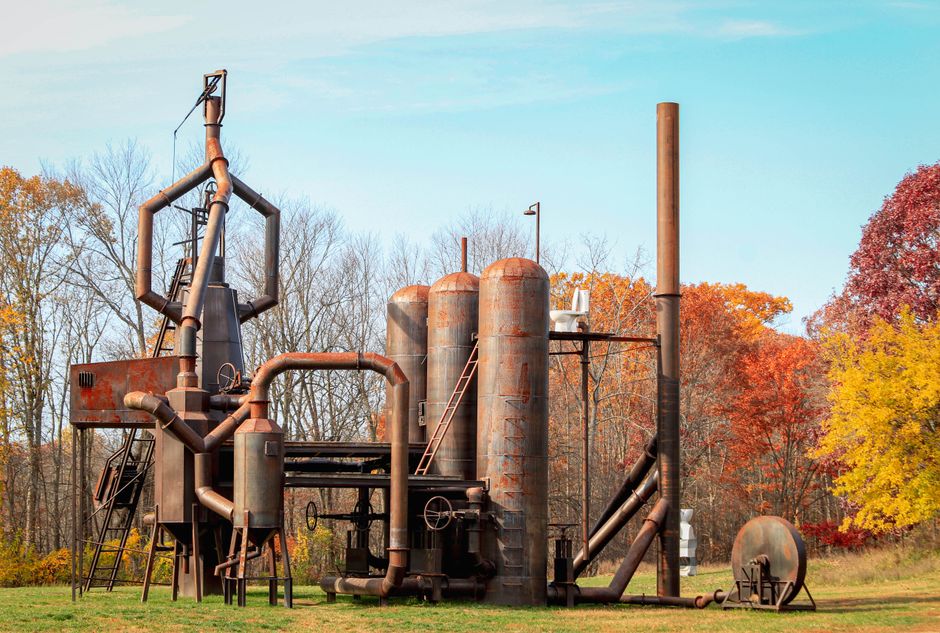
- Corten (Weathering) Steel: Corten steel is designed to rust — but only on the surface. When exposed to the elements, it develops a stable, protective, rust-like patina that seals the underlying steel against further corrosion. This warm, earthy, orange-brown finish is a favorite of minimalist and industrial artists.
- Recycled and Found Metal: From shipwreck hull plates to old car parts, using recycled metal adds historical weight and environmental consciousness to a piece. It requires careful cleaning and sealing but offers unmatched texture and character.
| Material | Aesthetic Finish | Average Lifespan | Common Engineering Challenge |
|---|---|---|---|
| Stainless Steel | Mirror-polished, brushed, or electroplated | 500+ years | High wind resistance (requires internal reinforcement or perforation) |
| Corten Steel | Warm, textured, orange-brown rust patina | 100+ years | Rust runoff can stain surrounding concrete plazas |
| Recycled Steel | Weathered, industrial, highly textured | Varies (depends on sealing) | Structural integrity must be thoroughly tested |
To learn more about how fabricators manipulate these materials to achieve specific textures and colors, dive into our guide on Fabricated Metal Art.
Defeating the Wind: Perforated and Openwork Designs
One of the greatest invisible enemies of a big metal sculpture is the wind. A massive, solid sheet of metal acts like a giant sail, catching wind currents and putting immense stress on the sculpture’s joints and foundation.
To combat this, engineers and artists often use perforated openwork designs. By cutting thousands of small holes or using a wire mesh structure, they allow wind to pass directly through the artwork. This drastically reduces wind resistance while creating beautiful, dappled light patterns on the ground. For dark, dramatic, and solid silhouettes that make a bold statement in indoor or protected outdoor settings, artists often turn to a black metal sculpture finish to emphasize form and shadow.
The Fabrication Process: How a Big Metal Sculpture is Born
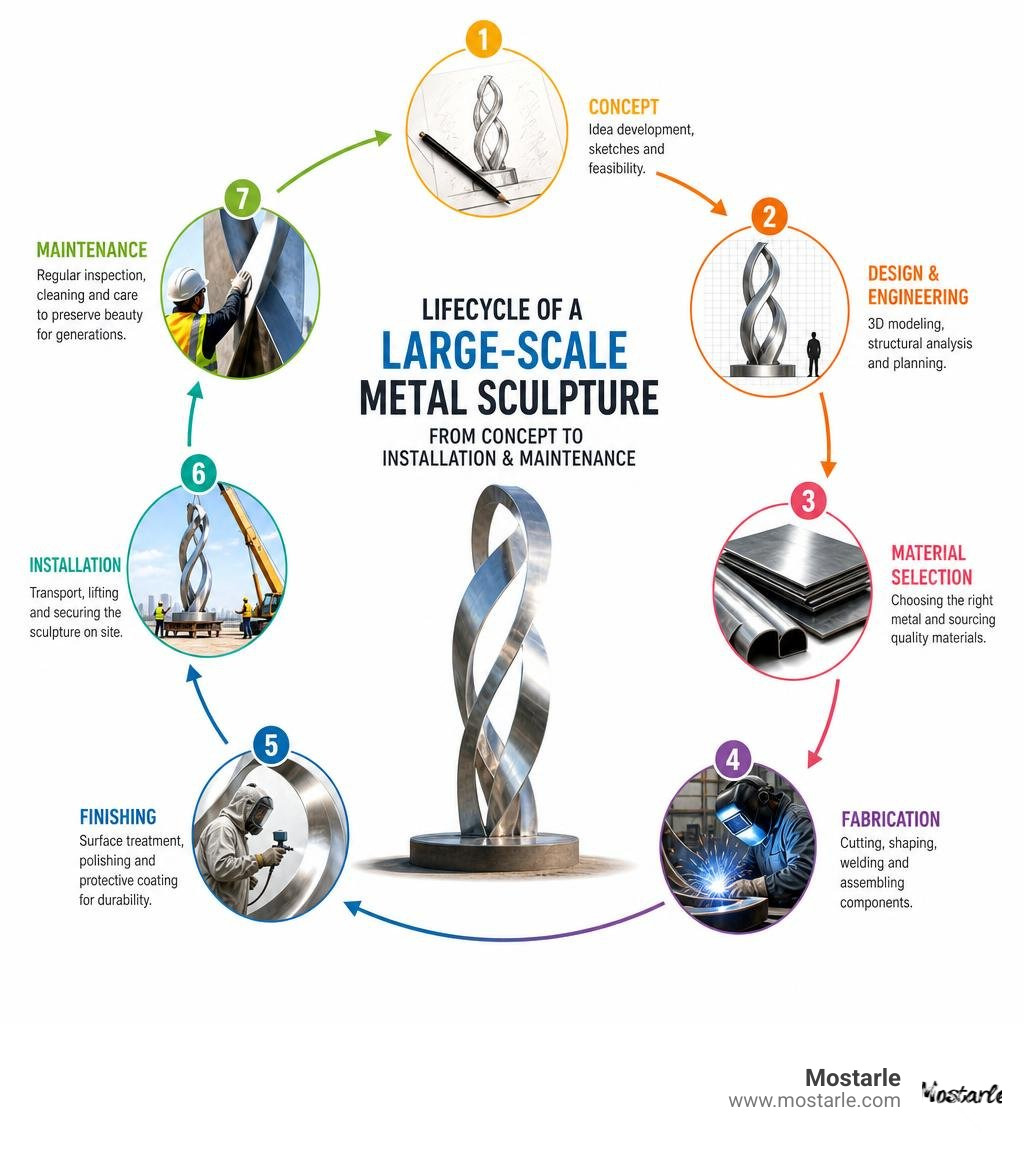
How do you go from a small sketch on a napkin to a multi-tonne monument? The journey of a big metal sculpture is a masterclass in industrial manufacturing.
Step 1: The Maquette and 3D Modeling
Every giant sculpture begins as a "maquette" — a small, hand-crafted scale model. Today, fabricators scan these maquettes into advanced 3D CAD software to calculate weight distribution, center of gravity, and structural stress points.
Step 2: Building the Internal Skeleton
Just like the human body, a massive metal sculpture needs a skeleton to keep it upright. Fabricators roll and weld thick steel plates to create internal rib systems. These structural ribs prevent the outer metal skin from buckling under its own weight or collapsing under external pressure.
Step 3: Cutting, Shaping, and Welding
Using CNC plasma cutters, laser cutters, or water jets, heavy metal sheets are cut into precise shapes. Heavy machinery then bends and rolls these plates to match the sculpture's curves. Skilled welders fuse the pieces together, often spending thousands of hours ensuring every seam is structurally sound and visually seamless.
Step 4: Sandblasting and Surface Treatment
Before any paint or sealant can be applied, the metal must be meticulously cleaned. Fabricators use high-pressure sandblasting — sometimes working in full, astronaut-like protective suits inside specialized blast chambers — to strip away mill scale, rust, and oil.
A fantastic example of this rigorous process is Eternal Winds, a 5,000-pound steel sculpture standing 24 feet tall and 22 feet wide in College Station, Texas. Created by a 79-year-old retired physician, the sculpture's fabrication involved intense sandblasting, the installation of thick internal ribs, and multiple coats of protective epoxy paint to withstand the humid Texas climate. Because of the unstable clay soil in the Brazos Valley, engineers had to drill four 14-foot-deep foundation holes packed with sand and concrete just to keep it anchored! You can read the inspiring story of this community project at Eternal Winds - The Arts Center .
For a deeper look into how custom metal pieces are brought to life from concept to completion, read our comprehensive Bespoke Metal Sculptures Guide 2026.
Kinetic vs. Static: Bringing Movement to Heavy Metal
While static sculptures rely on pure form and shadow, kinetic metal sculptures introduce a mesmerizing element: motion.

The Stabile: Monumental and Grounded
Static metal sculptures that sit firmly on the ground are often called stabiles. A classic historical example is Alexander Calder's The Big Ear (1943). Standing over 11 feet tall and constructed from heavy sheet metal and bolts, this monumental work was exhibited outside the American Pavilion at the 1952 Venice Biennale. It commands space through its heavy, unyielding presence. You can view archival details of this historic piece at The Big Ear (1943) | Calder Foundation .
Kinetic Masterpieces: Dancing with the Wind
Kinetic sculptures, on the other hand, use wind, water, or electric motors to move.
A world-famous example of a motorized kinetic sculpture is the Floralis Genérica in Buenos Aires, Argentina. This giant steel and aluminum flower weighs 18 tonnes and stands 23 meters high. Controlled by an automatic system, the massive petals slowly open every morning at 8:00 AM and close at sunset, mimicking the natural lifecycle of a real flower. It is a breathtaking blend of heavy industrial fabrication and delicate, lifelike movement. Learn more about visiting this kinetic marvel at Floralis Genérica - Turismo Buenos Aires .
Whether powered by complex gearboxes, gentle breezes, or solar-powered motors, kinetic metal sculptures challenge our perception of metal as a cold, rigid, and immovable medium.
Logistics, Installation, and Maintenance of Large-Scale Art
The journey of a big metal sculpture does not end in the fabrication shop. In fact, getting the sculpture to its final home is often the most stressful part of the entire project.
The Logistics Nightmare
Imagine driving a 13-tonne coiled steel sculpture down a public highway. When Lindy Lee's Ouroboros was moved from its fabrication site in Queensland to Canberra, the journey took nearly a week on the back of a specialized heavy-haulage truck. The route required:
- Police escorts and rolling road closures
- Trimming low-hanging tree branches along the highway
- Moving public road signs to clear the wide load
- Structural bridge assessments to ensure the highway could support the weight
The Crane Lift and Foundation
Once at the site, massive industrial cranes are brought in to lift the sculpture off the flatbed and lower it onto its foundation. Monumental sculptures require deep concrete footings, often reinforced with steel rebar and anchored with massive anchor bolts.
To learn more about how smaller-scale art pieces are secured, check out our guide on Elevate Your Art: Innovative Stands and Mounts for Metal Sculptures.
Long-Term Maintenance
Even the toughest metals require love and care. Outdoor sculptures are subjected to bird droppings, acid rain, UV rays, and pollution. Maintenance teams must regularly:
- Pressure wash the metal surfaces to remove grime
- Reapply protective wax coatings (especially on bronze or raw steel)
- Repaint or touch up epoxy coatings on painted steel works
- Inspect internal structural welds for signs of fatigue or stress cracking
Frequently Asked Questions about Big Metal Sculptures
How much does a big metal sculpture cost to commission?
The cost of a big metal sculpture varies wildly based on size, material, complexity, and the artist's reputation. A community-funded public art piece, like the Eternal Winds sculpture in Texas, can cost around $30,000 to construct and install. On the other end of the spectrum, world-class museum landmarks like Lindy Lee's Ouroboros can cost upwards of $14 million. Funding typically comes from a mix of municipal public art budgets, corporate sponsorships, and private donors.
What is the best material for a big metal sculpture placed outdoors?
For absolute longevity and minimal maintenance, stainless steel is the gold standard. It resists rust, acid rain, and environmental corrosion, offering a projected lifespan of over 500 years. However, if you prefer a warm, rustic, and organic aesthetic that blends beautifully with natural landscapes, Corten (weathering) steel is highly recommended because its self-protecting rust patina eliminates the need for repainting.
How do monumental metal sculptures withstand extreme weather?
Monumental sculptures are heavily engineered to withstand extreme winds, earthquakes, and temperature fluctuations. Engineers design them with internal structural skeletons (ribs), use perforated or openwork designs to let wind pass through safely, and anchor them to deep concrete foundations that extend far underground.
Conclusion
From the reflective, interactive curves of Lindy Lee's Ouroboros to the sprawling, earth-hugging lines of John Henry's Big Max, a big metal sculpture has an unmatched ability to capture our imagination. These giant creations prove that with the right blend of engineering, artistry, and passion, heavy industrial metal can be transformed into something light, poetic, and eternal.
At Mostarle, we operate on that very same wavelength. While we do not build 13-tonne monuments that require police escorts, we apply the exact same love for metal fabrication to our own creations. We transform ordinary, forgotten hardware — like nuts, bolts, and screws — into remarkable, creative models. It is our way of proving that creativity has absolutely no limits, whether you are working with a 75-foot steel beam or a handful of everyday workshop hardware.
Ready to explore metal art on a scale you can bring right into your living room? Dive into our guide on Understanding 3D Metal Puzzles and start your own creative journey today!