Expert Support

Crafting Mini Masterpieces: The Joy of Metal Model Making
Find the World of Metal Model Making

Metal model making is the art of changing flat metal sheets or everyday hardware into intricate three-dimensional sculptures. Whether you're assembling pre-cut laser-etched kits or creating original designs from found objects like nuts and bolts, this craft combines precision, patience, and creativity to produce stunning miniature masterpieces.
Quick Start Guide to Metal Model Making:
- Choose your approach - Start with pre-cut metal sheet kits (like Mostarle models) or experiment with found hardware objects
- Gather basic tools - You'll need needle-nose pliers, tweezers, and wire cutters at minimum
- Select a beginner project - Look for kits with under 100 pieces and simple geometric shapes
- Learn the technique - Master bending tabs, twisting connections, and shaping curves
- No glue required - Most metal kits use a clever tab-and-slot system for assembly
The hobby has exploded in popularity, with enthusiasts building collections of over 250 models. What makes metal model making unique is its accessibility—you don't need painting skills or expensive equipment to get started. The materials themselves provide the finish, whether it's gleaming stainless steel, warm brass, or the industrial character of repurposed hardware.
According to experienced builders, "there is absolutely nothing wrong with a simple model built well." This philosophy makes the craft welcoming for beginners while offering endless challenges. Some builders focus on assembling intricate laser-cut kits, like those from Mostarle. Others accept the artistic challenge of creating original sculptures from discarded fragments—proving that remarkable art can emerge from everyday materials.
The satisfaction comes from watching flat metal transform into recognizable forms: iconic buildings, vintage vehicles, mechanical insects, or abstract sculptures. Each completed model represents hours of focused work and stands as a tangible achievement you can display with pride.
For readers who would like a broader context on where this hobby sits within the wider world of scale modeling and miniatures, the overview of model building offers useful background on techniques and traditions that also influence metal model making.
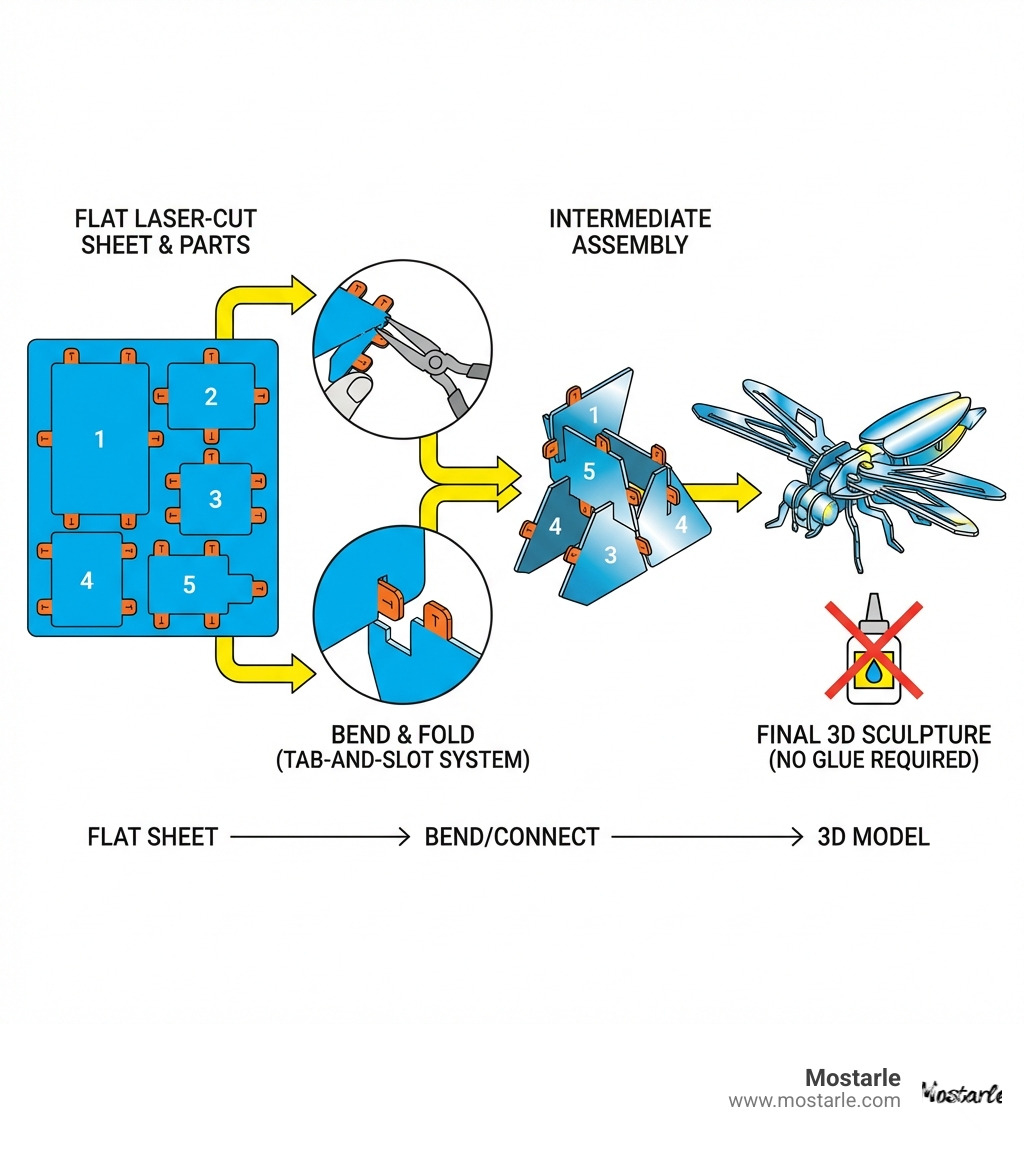
Metal model making terms to remember:
Getting Started: Your First Metal Model
This section covers everything a beginner needs to start their journey, from tools to their first Mostarle kit. For metal model making, having the right gear and a clear starting point makes all the difference. This means understanding the essential tools and choosing a first project that builds confidence, not frustration.
Essential Tools for Metal Model Making
While some basic kits suggest you can get by with just your fingers, having the right tools significantly improves the process and the final result. They allow for greater precision, prevent damage to delicate parts, and make the experience more enjoyable.
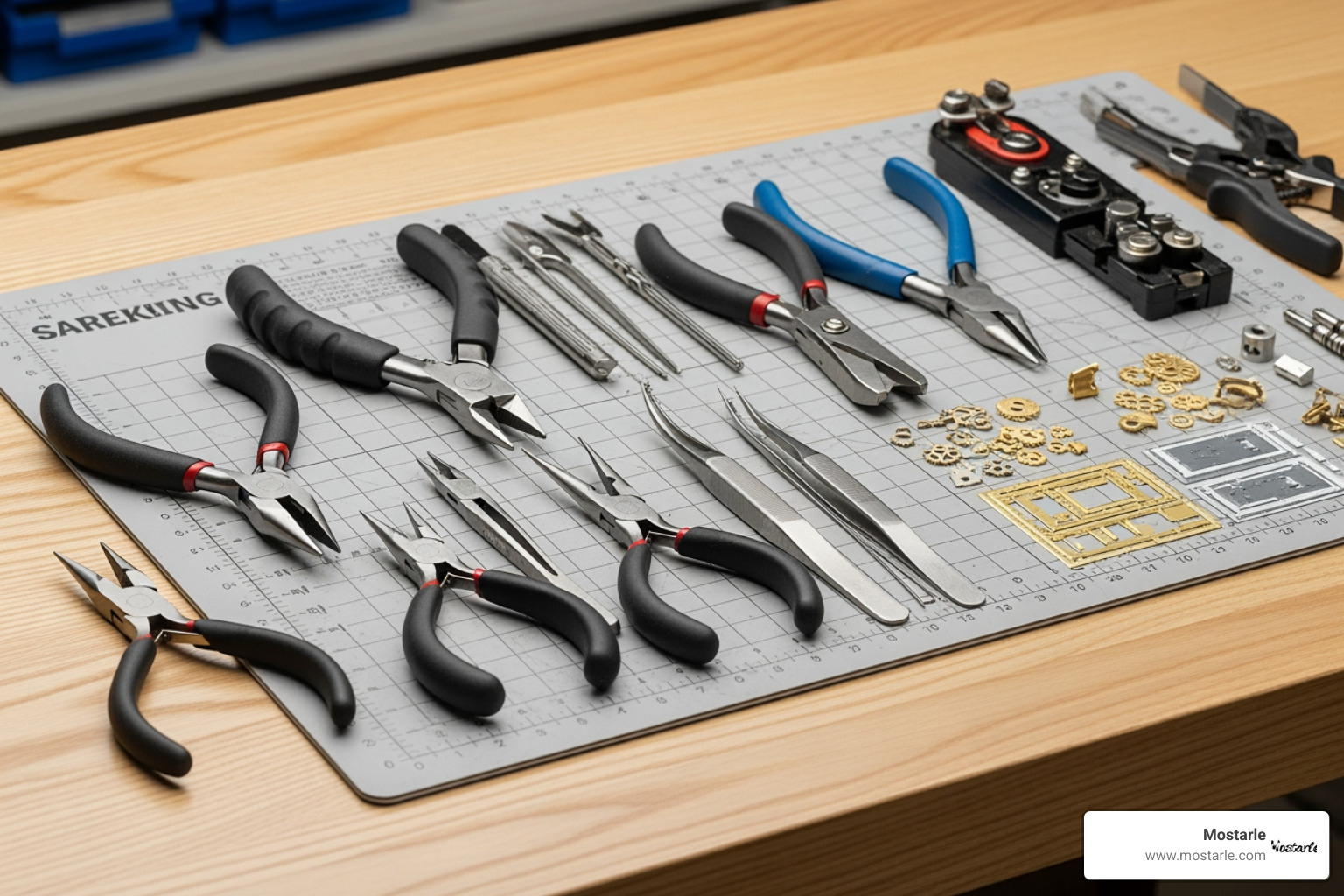
Here’s what we consider essential for any aspiring metal model maker:
- Needle-Nose Pliers: These are our workhorses. They're perfect for gripping small tabs, bending straight edges, and twisting connection points. A good pair will have fine tips for intricate work.
- Tweezers: For those tiny, fiddly pieces that even needle-nose pliers can't quite grasp, precision tweezers are invaluable. They help us position parts accurately and hold them steady while we make connections.
- Wire Cutters (or Clippers/Side Cutters): These are crucial for cleanly detaching parts from the metal sheets. A clean cut prevents burrs and reduces the risk of bending or damaging the part as it's removed. We recommend cutting the smallest section first and always cutting from the rear of the sheet to avoid scratching fine details.
- Bending Aids: While pliers can handle many bends, specialized bending tools or even household items like pens and pencils can help us achieve perfectly curved or cylindrical shapes. A ruler is excellent for ensuring long, straight folds are crisp.
- Cutting Mat: This protects our work surface from scratches and provides a stable, non-slip area for assembly.
- Good Lighting: Clear visibility is paramount when working with small, shiny metal parts. A bright, adjustable desk lamp reduces eye strain and helps us see every detail.
- Magnification: For very intricate models or those with tiny details, a magnifying lamp or even reading glasses can be a game-changer.
As we progress, we might add a hobby knife for precise cuts, sanding pads or files for smoothing edges, or even a micro-driver for kits that incorporate small screws. "The process can be faster and more enjoyable with a few simple tools."
For more in-depth guidance on selecting and using your tools, we encourage you to explore resources like our own A Guide to Building Metal Model Kits (Mostarle Resource).
Choosing Your First Project
Starting with the right model is key to a positive first experience in metal model making. We want our first build to be a satisfying success, not a frustrating ordeal. The market for 3D metal model kits is vast, with some complex kits containing over 700 pieces, but these are not where we'd recommend a beginner start.
For beginners, we suggest Mostarle kits labeled as "easy" or "beginner." These typically have fewer than 50 pieces, involve simple folds, and come on a single metal sheet. Models with less intricate detail and more geometric shapes are ideal for practicing fundamental techniques without being overwhelmed.
Here's a list of recommended beginner Mostarle model themes that often feature simpler designs:
- Single-Sheet Architectural Icons: Think small, recognizable landmarks that primarily involve straight folds and minimal curves.
- Simple Vehicles: Classic cars or basic airplanes with fewer exposed intricate parts.
- Iconic Characters or Symbols: Designs that are more stylized and less hyper-realistic, reducing the number of tiny components.
- Our Mostarle Original Models: Look for our specific recommendations, such as the Dragonfly model, which is designed to introduce fundamental techniques in a manageable way. As we advise in our Beginner Tips for Building Your First MostarLe Metal Model: Start with the Dragonfly, a well-chosen first project sets the stage for future enjoyment.
The goal for our first project is to build confidence and learn the basic mechanics of tab-and-slot assembly. Once we've successfully completed a few simpler models, we can gradually move on to more complex designs with more pieces and intricate details.
The Art and Science of Metal Model Making
This step-by-step guide to the assembly process focuses on techniques for a successful build. This is where flat metal pieces become stunning three-dimensional creations, requiring a blend of artistic vision and scientific precision.
Decoding the Blueprint: How to Read Instructions
Before touching any metal, the first step is to understand the instructions. Think of it as your blueprint. Mostarle kits typically use visual, step-by-step diagrams rather than lengthy text, making them universally accessible.
Here's how we approach decoding our blueprints:
- Read Through Completely: We always start by scanning the entire instruction sheet. This gives us a general overview of the build sequence and helps us identify potential challenges upfront.
- Part Numbers and Identification: Each part on the metal sheet will have a corresponding number in the instructions. We make sure to locate these on the sheet before detaching anything.
- Visual Cues and Symbols: Pay close attention to the symbols used. For example, many kits use specific indicators for different types of bends and twists. A common practice is using a blue dot for a 90° bend and a green triangle for a 90° twist. These symbols are vital for getting the correct shape and connection.
- 3D Diagrams: The instructions often feature isometric or exploded 3D diagrams. These are incredibly helpful for visualizing how parts fit together and confirming the correct orientation.
- Assembly Order: The instructions will guide us through the logical assembly sequence. It's usually best to follow this order diligently, as skipping steps can lead to difficulties later on.
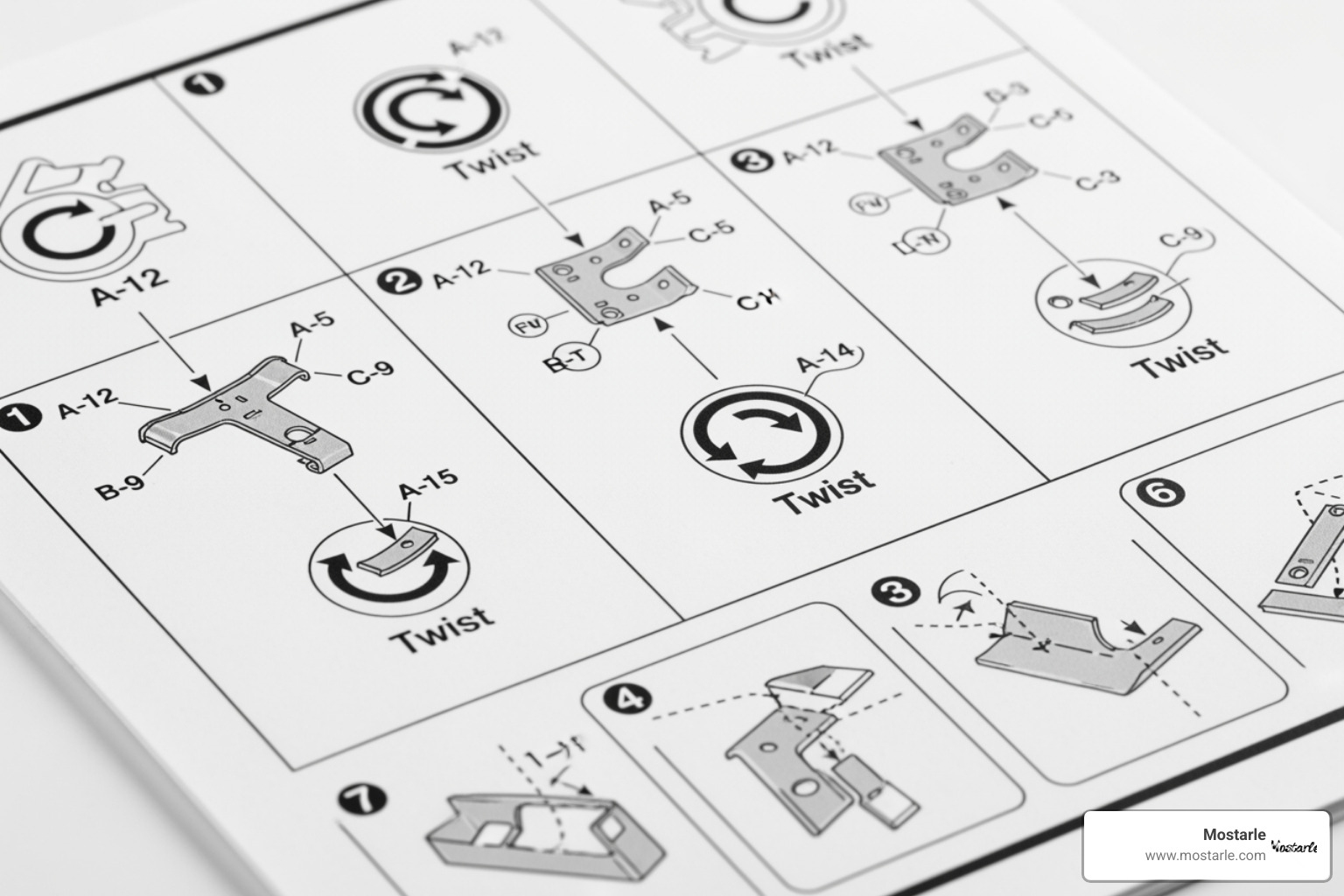
By taking our time to understand these visual cues, we ensure a smoother and more accurate build.
From Sheet to Sculpture: Assembly Techniques
With our blueprint understood, we can now begin the exciting process of bringing our metal model making project to life. The core of this craft lies in a few fundamental techniques that transform flat metal into a rigid, detailed sculpture.
- Detaching Parts: Using our wire cutters, we carefully snip each part from the metal sheet. We always cut as close to the part as possible without damaging the detail, making sure to clip the smallest section first. Remember to cut from the rear of the sheet to avoid scratching the front.
- Bending Tabs: Most metal models use a tab-and-slot system. After detaching a part, we'll see small tabs designed to fit into corresponding slots. These tabs need to be bent to an appropriate angle (often 90°) to secure the connection. Our needle-nose pliers are perfect for this.
- Twisting Tabs: For some connections, especially those requiring a more secure or permanent bond without glue, tabs are twisted rather than just bent. This locks the parts together. Again, precision pliers or tweezers are our best friends here.
- Shaping Curves and Forming Cylinders: Many models feature curved surfaces or cylindrical components. For these, we can use our bending aids or even household items like pens, pencils, or dowels to gently roll and shape the metal. Patience and a light touch are key to achieving smooth, even curves.
- Joining Components: Once tabs are bent or twisted, we carefully insert them into their slots. Sometimes this requires a bit of gentle pressure or wiggling. We always test-fit parts before making any final bends or twists to ensure a perfect alignment.
As we demonstrate in Build Great Scale Models with Mostarle, precise execution of these techniques is what turns a collection of flat pieces into a miniature masterpiece. The absence of glue or solder means the structural integrity relies entirely on these mechanical connections.
Avoiding Common Pitfalls
Even experienced builders encounter challenges, but many common mistakes are avoidable with foresight and patience. As one builder noted, "Patience is a virtue that helps build better models!"
Here are some pitfalls we've learned to avoid:
- Over-Bending Parts: Metal can only be bent so many times before it weakens and eventually breaks. This is especially true for tabs. We always aim for a single, clean bend. "Breakages usually happen when parts are bent too far, or too fast," so we recommend taking it slow.
- Breaking Tabs: This is perhaps the most common and frustrating mistake. Tabs are delicate. Avoid trying to bend them before detaching the piece from the sheet, and use the correct tools (pliers, tweezers) for gentle manipulation.
- Using Wrong Tools: Trying to force a bend with blunt tools or using fingers for delicate work can damage parts. Always use the appropriate fine-tipped pliers or tweezers.
- Rushing the Process: Metal model making is not a race. Rushing leads to mistakes, bent parts, and frustration. We find that taking breaks, especially on complex models that can take several hours over a few days, helps maintain focus and enjoyment.
- Losing Small Pieces: Many kits have incredibly tiny parts. We always work in a clear, organized workspace and keep a small tray or container for detached pieces. Clipping parts from the sprue only as we need them also helps prevent mix-ups and losses.
- Fingerprints on Finish: The gleaming metal surfaces can easily pick up fingerprints and oils, especially on glossy or pre-colored models. Some builders wear surgical gloves or cotton finger cots. Alternatively, we can clean finished models with a cotton bud and a non-ammonia window cleaner. Our Maintenance Guide for 3D Metal Puzzles offers more tips on keeping your models pristine.
By being mindful of these common issues, we can significantly improve our building experience and the quality of our finished models.
Beyond the Instructions: Repairs, Customization, and Creative Styles
Once we've mastered the basics, metal model making opens up even further. We can learn to fix inevitable mishaps, personalize our creations, and even venture into entirely new artistic expressions.
Troubleshooting and Repairs
Even the most careful builders will, at some point, encounter a bent piece or a broken tab. The key is "don't panic!" Most issues are fixable, and learning to troubleshoot is part of the hobbyist's journey.
- Fixing Broken Tabs: If a tab breaks off, we have a few options. For a quick fix on an unseen area, apply sticky tape to the back of the part across the break, trim it, and add a tiny drop of superglue to the outside for reinforcement. For parts needing more structural integrity, a two-part epoxy provides a stronger bond. Alternatively, a small amount of modeling clay inside the model can provide internal support for a broken part.
- Re-attaching Parts: If a part detaches unintentionally, we can often re-bend the tab or carefully re-insert it. If the tab is too weak, a tiny drop of superglue can be used as a last resort, though Mostarle kits are designed to be glue-free.
- Straightening Bent Pieces: For parts that are merely bent rather than broken, we use our needle-nose pliers or flat-nose pliers to gently reshape them. We apply even pressure and work slowly to avoid further damage.
While Mostarle aims for robust designs, if a critical part from one of our kits is irreparably damaged, contacting our customer service for a replacement part is always an option.
Personalizing Your Creation
While the natural metallic sheen of Mostarle models is beautiful on its own, some of us enjoy adding a personal touch through customization. "Can metal models be customized, such as by painting them?" Absolutely! Painting metal models is a fantastic way to add realism, vibrancy, or a unique artistic flair.
-
Painting Models: Before painting, we ensure the metal surface is clean and free of oils (from fingerprints) and dust. A light primer designed for metal can help paint adhere better.
- Airbrushing: For smooth, even coats and intricate details, airbrushing is an excellent option. It allows for fine control and professional-looking finishes.
- Hand-Painting: For smaller details, weathering, or a more artistic, brush-stroke effect, hand-painting with fine brushes and acrylic or enamel paints works well.
- Adding Custom Details: We can use small plastic or metal accessories from other modeling kits, or even tiny pieces of wire and other materials, to improve our models. This is particularly appealing for creating unique dioramas or scenes.
- Weathering Effects: To give a model a more "used" or aged look, we can apply weathering techniques using washes, dry-brushing, or pigments. This can simulate rust, grime, or wear and tear.
- Creating Dioramas: Placing our finished models in a diorama setting adds context and narrative. This involves building a base, adding scenery elements like miniature trees, rocks, or buildings, and arranging our model within the scene.
For more detailed guidance on changing your models, our How to Customize Your 3D Metal Puzzle Kit provides excellent starting points.
Exploring Different Styles
Beyond assembling pre-designed kits, metal model making offers a spectrum of creative possibilities. At Mostarle, we celebrate the diverse ways metal can be transformed into art.
- Mostarle Sheet Metal Kits: These are our popular laser-cut kits, made from high-quality stainless steel or brass sheets. They offer intricate details and precise fit, allowing us to build detailed replicas of everything from architectural marvels to fantastical creatures using the tab-and-slot assembly method. This is where the magic of "amazing DIY models with stunning details" truly shines.
- Scratch Building with Mostarle Parts: For those who enjoy designing their own models, our individual metal sheets and structural components can be used for scratch building. This involves conceptualizing a design and then cutting, shaping, and assembling metal pieces from raw materials or our existing kit parts to create something entirely new.
- Found Object Sculpture: This is where Mostarle's unique approach truly comes to life. We believe creativity has no limits, and that ordinary, forgotten fragments can be transformed into remarkable pieces. Imagine turning old nuts, bolts, washers, and other discarded hardware into a whimsical robot, a fierce animal, or an abstract sculpture. This style, often called assemblage), repurposes everyday items, giving them new meaning and form. Our The Art of Assemblage: Discovering Found Object Sculptures blog explores this fascinating avenue of metal art. It's about seeing the artistic potential in the industrial, turning what others discard into a treasure.
Whether we're carefully following instructions or letting our imagination run wild with a pile of hardware, the journey of metal model making is deeply rewarding.
Embracing the Hobby: Costs, Benefits, and Building a Collection
Metal model making is more than just a pastime; it's a journey into precision, creativity, and personal growth. As we dig deeper, we find not only the joy of crafting but also the many benefits this hobby brings, both to our minds and our living spaces.
The Hobbyist's Budget: Cost Considerations
A great thing about metal model making is its scalable cost. You can start affordably and invest more as your passion grows.
- Mostarle Kit Prices: Beginner-friendly kits can start from around $10-$20, making them an accessible entry point. As models become more complex, with more pieces (some exceeding 700 or 2100 pieces) or larger scales, prices can range from $30 to over $100.
- Tool Costs: An initial investment in essential tools like pliers, tweezers, and cutters might be around $20-$50. These tools are durable and will last for many projects. Specialized bending aids or a good cutting mat might add another $10-$30. As we heard from experienced builders, "a good tool kit for enhancing the building process and results in metal model making" is a worthwhile investment.
- Display Cases, Paints, and Supplies: If you choose to paint your models or invest in display cases, these are additional costs. A quality display case can range from $20 to $100+, depending on size and material. Paints and weathering supplies are relatively inexpensive.
- Starting Affordably: We recommend starting with a basic kit and the core tools. This allows you to gauge your interest without a significant financial commitment. The market for 3D metal model kits is robust, with many options across various price points.
- Long-Term Investment: Over time, your tool collection might grow, and you might accumulate a substantial number of models. However, the cost per model remains quite reasonable, especially considering the hours of enjoyment and the lasting display piece you create. The hobby offers an excellent return on investment in terms of personal satisfaction.
Benefits of Metal Model Making as a Hobby
Beyond the beautiful finished products, metal model making offers many cognitive and emotional benefits. The deep immersion in the process brings several advantages:
- Patience and Focus: The intricate nature of fitting tiny tabs into slots or carefully bending delicate pieces demands and cultivates immense patience and concentration. This focused attention can be a wonderful antidote to daily distractions.
- Fine Motor Skills: Manipulating small parts with precision tools significantly improves dexterity and hand-eye coordination.
- Spatial Reasoning: Reading 3D diagrams and visualizing how flat pieces will form a three-dimensional object sharpens spatial awareness and problem-solving skills. As our The Connection Between 3D Metal Puzzles and STEM Education highlights, this hobby is a fantastic way to engage with STEM principles.
- Stress Relief: The meditative quality of focused, hands-on work can be incredibly therapeutic. It provides a healthy distraction and a sense of calm, as many builders attest to finding "significant joy and healthy distraction."
- Sense of Accomplishment: There's immense satisfaction in watching a collection of flat metal pieces transform into a detailed model. Each completed project is a tangible representation of your skill and perseverance.
- Creativity and Expression: Whether following a kit's design or crafting unique sculptures from found objects, this hobby offers a rich outlet for creative expression.
In a world filled with digital screens, the tactile experience of metal model making provides a refreshing and deeply human engagement.
Curating and Displaying Your Collection
After spending hours building your miniature masterpieces, you'll want to display and protect them. Building a collection is part of the fun, with many enthusiasts accumulating "collections of over 250 models."
- Themed Collections: A great way to organize your models is by theme. You might have a collection of architectural wonders, a fleet of iconic vehicles, a menagerie of mechanical animals, or a showcase of fantastical creations. Themed displays create a cohesive and visually striking presentation.
- Display Cases: The most effective way to protect models from dust and accidental damage is to house them in clear display cases. Acrylic or glass cases not only keep them pristine but also lift their presentation.
- LED Lighting: Adding subtle LED lighting within or around display cases can dramatically improve the visual appeal of your models, highlighting their intricate details and metallic sheen.
- Rotating Stands: For particularly impressive models, a rotating stand allows you to admire them from all angles, showcasing every facet of your hard work.
- Shelving Ideas: Open shelving can work for larger collections, but you'll need to commit to regular dusting. Floating shelves can create a modern, uncluttered look. For inspiration on how to best showcase your creations, our Elevate Your Art: Innovative Stands and Mounts for Metal Sculptures offers creative ideas.
- Protecting from Dust: Even without cases, a soft brush or a can of compressed air for regular dusting will keep your models looking their best.
Displaying your collection is the final rewarding step in the metal model making journey, allowing you to share your passion and artistry with others.
Frequently Asked Questions about Metal Model Making
What are the best metal model kits for a complete beginner?
For beginners, it's best to start with Mostarle kits labeled as "easy" or "beginner." These typically have fewer than 50 pieces, involve simple folds, and come on a single metal sheet. Look for models with less intricate detail and more blocky, geometric shapes, such as small architectural landmarks or simple vehicles.
Do I need to use glue or solder to build these models?
Most Mostarle 3D metal model kits are designed to be assembled without any glue or solder. They use a clever system of tabs and slots that you bend or twist to hold the model together, creating a strong mechanical bond.
How do I clean and maintain my finished metal models?
To maintain your models, dust them regularly with a soft brush or a can of compressed air. To remove fingerprints from glossy surfaces, use a microfiber cloth lightly dampened with a non-ammonia glass cleaner. For long-term protection, consider displaying your collection in a sealed acrylic or glass case.
Conclusion: Start Your Metal Crafting Adventure
Metal model making is a rewarding hobby that combines precision, creativity, and patience, resulting in stunning miniature masterpieces. Whether you're assembling a Mostarle kit or creating unique sculptures from everyday hardware, the process offers a fulfilling escape and a tangible sense of achievement. We've explored the essential tools, the art of deciphering instructions, techniques for assembly, and how to troubleshoot common issues. We've also touched on the joy of personalizing your creations, the diverse styles within the craft, and the many benefits it brings to our lives. Ready to dive deeper and explore the possibilities? Understanding 3D Metal Puzzles.