
The Ultimate List of Complex Puzzles for Adults Who Love a Challenge
Why Complex Puzzles for Adults Are Having a Major Moment

If you're looking for the best complex puzzles for adults, here's a quick overview of the top types to consider:
| Puzzle Type | Difficulty | Best For |
|---|---|---|
| 3D Metal Mechanical Models | Very High | Engineering-minded adults |
| Sequential Discovery Puzzles | Very High | Logic and patience lovers |
| Burr & Disentanglement Puzzles | High–Very High | Spatial reasoning challenges |
| 1000+ Piece Gradient Jigsaws | High | Visual pattern recognition |
| Wooden Tessellated Puzzles | High | Tactile, artistic puzzlers |
Something is shifting in how adults spend their downtime. The global jigsaw and puzzle market was valued at around $1.2 billion in 2023 and is on track to hit $1.8 billion by 2030. A big part of that growth? Adults actively seeking harder challenges — not easier ones.
A 2022 survey found that 65% of adult puzzle enthusiasts prefer "difficult" or "expert" level puzzles, with mental stimulation and stress relief as their top reasons.
And it's not just flat cardboard jigsaws anymore.
3D metal puzzle kits, sequential discovery locks, burr puzzles, and precision laser-cut mechanical models have opened up a whole new category of challenge. These aren't novelty items — they're engineering exercises disguised as entertainment.
Whether you want something that takes an afternoon or something that takes weeks to crack, this guide covers the most rewarding complex puzzles available right now — and exactly what makes each one worth your time.

The Science Behind Complex Puzzles for Adults

Why do our brains actively seek out challenges that make us scratch our heads, sigh in frustration, and spend hours staring at tiny pieces of metal or wood? The answer lies deep within our neurobiology. When we tackle a highly challenging mental task, we are not just passing the time; we are giving our brains a rigorous workout.
To understand why this is so beneficial compared to passive entertainment, we can look at the differences between standard activities and highly engaging, multi-dimensional tasks in Beyond Sudoku: A Guide to Truly Brain-Stimulating Puzzles.
Cognitive Benefits of Solving Complex Puzzles for Adults
Engaging with complex puzzles for adults regularly acts as a catalyst for neuroplasticity—the brain’s ability to reorganize itself by forming new neural connections. This is particularly crucial as we age. Studies indicate that solving complex puzzles can improve cognitive function by up to 20% in adults over 50, with regular engagement linked to a reduced risk of cognitive decline and dementia.
When you solve a 3D mechanical puzzle or a complex geometric puzzle, you are forcing your brain to exercise several distinct cognitive skills simultaneously:
- Spatial Reasoning and 3D Visualization: You must mentally rotate objects, project how pieces will fit together in three dimensions, and understand how moving parts interact.
- Working Memory: Remembering where a specific notch was, or keeping track of a multi-step sequence of moves, stretches your short-term memory capacity.
- Problem-Solving and Logic: You form hypotheses ("If I slide this bolt, then that gear should release") and systematically test them, building resilience against cognitive fatigue.
Stress Relief and Mindfulness
It might seem paradoxical that an extremely difficult puzzle—something that can be "beautifully maddening"—promotes stress relief. However, the mechanism is simple: deep focus.
When you dive into a complex puzzle, your brain enters a state of "flow"—a psychological state of optimal activation where you are fully immersed in the present moment. This intense focus quietens the "default mode network" of the brain, which is responsible for mind-wandering, anxiety, and stress.
Furthermore, every time you successfully connect a difficult piece or unlock a hidden compartment, your brain releases a micro-dose of dopamine, the reward neurotransmitter. This tactile engagement and the physical satisfaction of feeling high-quality materials click together provide a grounding, screen-free mindfulness practice that digital games simply cannot replicate.
The Most Challenging Formats: From Sheet Metal to Mechanical Masterpieces
To find your perfect level of frustration and triumph, it helps to understand the different formats of complex puzzles. Let's look at how the primary metal-based puzzle categories stack up against each other:
| Feature | Sheet-Metal DIY Kits | Screw-and-Bolt Mechanical Models | Sequential Discovery Puzzles |
|---|---|---|---|
| Primary Material | Thin sheet steel/brass | Heavy hardware (nuts, bolts, solid metal) | Machined brass, aluminum, or steel |
| Average Piece Count | 100 - 1,000+ | 200 - 1,500+ | 5 - 20 (highly complex internal parts) |
| Assembly Time | 3 - 15 hours | 4 - 30+ hours | Minutes to days (solving, not building) |
| Main Challenge | Delicate bending, high patience | Structural engineering, mechanical alignment | Logic, hidden steps, spatial reasoning |
| Tools Required | Tweezers, needle-nose pliers | Screwdrivers, wrenches (usually included) | None (hands-on manipulation) |
To explore which format matches your personal puzzle-solving style, check out our comprehensive breakdown in The Ultimate Guide to Adult Puzzles: Find Your Next Challenge.
Precision-Cut 3D Metal Puzzles
These puzzles typically arrive as flat, laser-cut metal sheets, often made of stainless steel or brass. Solvers must carefully pop out the pieces and bend tiny metal tabs to slot them together.
The difficulty here lies in the sheer precision required. One wrong bend can compromise the structural integrity of the entire model. Over 70% of buyers of premium 3D metal and wooden puzzles priced over $50 report spending 4 or more hours per session, with 40% completing their projects over multiple days. The result is a stunning, shiny piece of hardware art that you built entirely with your own hands.
3D Metal and Mechanical Puzzles
Taking the challenge a step further, screw-and-bolt mechanical puzzles rely on industrial hardware components like threaded rods, gears, nuts, and bolts. Instead of folding delicate tabs, you are literally assembling a machine.
These puzzles demand an understanding of gear mechanisms, leverage, and structural engineering. The tolerance levels are exceptionally tight, meaning if one bolt is slightly too loose or too tight, the gears won't turn.
At Mostarle, we specialize in this very realm, transforming ordinary, forgotten fragments of everyday hardware into remarkable, creative pieces. We believe that creativity has no limits, and assembling these heavy, tactile pieces offers an unmatched sensory experience.
To gauge how much of a challenge you are ready to take on, read our guide on 3 Levels of Difficulty: How to Find a 3D Puzzle That Offers the Right Level of Challenge. If you want to dive straight into why these heavy, hardware-based creations are so uniquely captivating, explore Beyond the Ordinary: Engaging Metal Puzzles to Sharpen Your Wit.
Top Recommendations for Mind-Bending Challenges
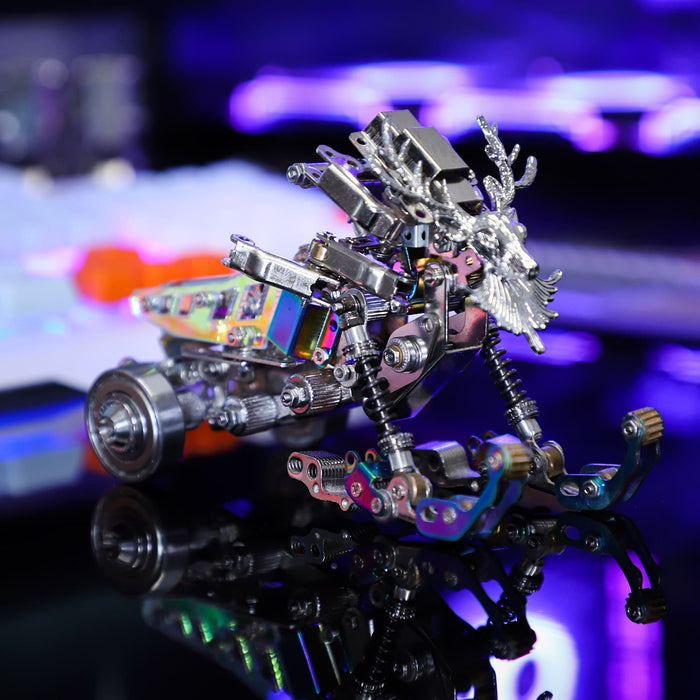
If you are ready to test your limits, we have compiled some of the most challenging, highly rated, and beautifully designed puzzles available across different categories. These selections represent the pinnacle of modern puzzle design, combining artistic aesthetics with mind-melting complexity.
Mind-Bending Geometric and Mechanical Designs
For those who love visual and structural complexity, geometric and specialized artistic puzzles offer a fantastic test of patience.
- The Symmetrical and Cybernetic Grayscale Challenges: Puzzles featuring incredibly intricate, futuristic vector artwork—such as the Cybernetic Enlightening Jigsaw Puzzle by Tricky Woo - PX Puzzles or the Intricate Symmetrical Design in Monochrome Jigsaw Puzzle by Tricky Woo - PX Puzzles—rely on fluid lines, sharp points, and minimal color contrast. The lack of distinct visual anchors forces you to focus entirely on tiny shifts in pattern and line weight.
- Tessellated and Fractal Wooden Puzzles: Wooden puzzles cut with repeating, mathematical shapes are notoriously difficult. The Fractal Fun (354 Piece Wooden Jigsaw Puzzle) Extra Difficult | Nautilus Puzzles and the Hard Puzzle: Tidepool Tapestry- 397 Piece Wooden Puzzle | Nautilus Puzzles utilize tessellated cuts where pieces fit together in non-standard, repeating ways. This design prevents you from using standard edge-first sorting strategies.
- The "No-Edge" Edge Puzzle: If you want to completely throw your traditional jigsaw strategies out the window, look at the EDGE PIECE PUZZLE: BIRTHDAY HEIST ON THE HILLSIDE – Yetch Studio. In this brilliant design, 356 out of 538 pieces are actually edge pieces, meaning almost the entire puzzle consists of straight outer borders!
- High-End Wood Cuts: For classic wooden designs that use split tendril connectors, irregular edges, and fewer "whimsy" pieces (which usually make puzzles easier), explore the collection of Extra Difficult Jigsaw Puzzles or browse through Extra Difficult Puzzles.
Sequential Discovery and Disentanglement Metal Puzzles
If you prefer solving an object rather than assembling one, sequential discovery and disentanglement puzzles are the gold standard.
- Sequential Discovery Locks and Boxes: These puzzles require you to find hidden tools, slide panels, and decode mechanisms in a specific order to open a compartment. Some advanced Japanese puzzle boxes or trick locks can require dozens of precise moves to unlock.
- Disentanglement and Burr Puzzles: These classic brain teasers require you to separate interlocking metal rings or wooden blocks. You can find some of the rarest and most complex mechanical puzzles of this style through collections like Extreme Difficult Puzzles - Kubiya Games and Brain Boggling Puzzles.
- Logic-Based Sudoku and Grid Variants: If your logical mind prefers pen-and-paper or digital grid-based deductions, the legendary German portal hosts incredibly complex logic variants like The Answer to the Ultimate Question — Rätselportal — Logic Masters Deutschland, featuring complex "Copycat" rules and fog-of-war mechanics that require hours of intense logical deduction.
- Global Finds: If you are hunting for highly rated, widely accessible challenges to start your journey, you can also browse options like Jigsaw Puzzle Argentina - Walmart to discover high-piece challenges available in your region.
Expert Strategies for Solving Difficult Puzzles
Tackling a highly complex puzzle without a plan is a quick way to end up with a headache and a box of half-assembled pieces. To help you conquer even the most daunting designs, we’ve compiled the ultimate strategies used by master solvers. For a deep dive into 3D-specific techniques, check out our 9 Tips for Solving Difficult 3D Puzzles.
Pro Tips for Conquering Complex 3D Metal Puzzles
- Prepare Your Workspace: You need a clean, flat, well-lit surface. Use a white or light-colored assembly mat so tiny screws, bolts, or tabs don't vanish into the background.
- Organize Before You Assemble: Do not open all the bags of parts at once. Keep pieces in their labeled bags or organized in small trays. If you are building a sheet-metal model, keep the sheets intact until the instructions explicitly tell you to remove a part.
- Invest in the Right Tools: While some kits come with basic tools, having a high-quality pair of needle-nose pliers, precision tweezers, and a magnetic screwdriver will save you hours of frustration and prevent hand cramps.
- Study the Schematics Carefully: 3D puzzle instructions are highly visual. Pay close attention to the orientation of parts, gear directions, and locking mechanisms before tightening any screws.
Logic-Based and Sequential Discovery Techniques
When dealing with disentanglement, burr, or sequential discovery puzzles, brute force is your worst enemy. If you have to pull, bend, or force a piece, you are likely doing it wrong. Instead, focus on these logic-based habits:
- Map the Movements: Observe how pieces slide, rotate, or tilt. Note which movements are blocked and what is causing the obstruction.
- Work Backwards: If you make a sequence of moves, try to immediately reverse them to understand the path you took. This prevents you from getting a puzzle hopelessly stuck in an unknown state.
- Understand the Physics: For ring and string puzzles, success lies in understanding spatial topology. To learn the secrets behind these classical challenges, read our guide on The Art of Disentanglement: Solving Intricate Metal Ring Puzzles.
Frequently Asked Questions about Complex Puzzles
What makes a 3D metal puzzle "impossible" to solve?
A 3D metal puzzle earns its "impossible" reputation through a combination of ultra-high precision requirements, non-intuitive interlocking mechanisms, and hidden steps. Unlike flat puzzles where you can see all your options at once, 3D metal puzzles often feature internal gear alignments, hidden pins, or microscopic tolerances where a fraction of a millimeter determines whether a piece will move.
How do I choose the right difficulty level for a 3D metal puzzle?
When selecting your next project, look closely at the estimated building time, piece count, and mechanical complexity rather than just the age recommendation. If you are new to the hobby, starting with a model that has fewer moving parts and uses larger hardware components is highly recommended. To help you navigate the buying process, explore our expert insights in Beyond the Ordinary: Discovering Complex Metal Puzzles and find out what to look for in Difficult Metal Puzzles.
Why are 3D metal puzzles more challenging than traditional flat puzzles?
Traditional flat puzzles primarily test your visual pattern recognition and shape matching in two dimensions. 3D metal puzzles, on the other hand, require advanced spatial reasoning, structural engineering principles, and physical dexterity. You aren't just matching colors; you are aligning gears, securing load-bearing joints, and using physical tools to create permanent mechanical connections.
Conclusion
At Mostarle, we believe that the joy of puzzling lies in the journey of transformation. By taking everyday hardware like nuts, bolts, and metal fragments and turning them into intricate, mind-bending sculptures, we celebrate the limitlessness of human creativity.
Taking on a complex puzzle is more than a way to pass a quiet weekend—it is an investment in your cognitive health, a masterclass in patience, and a deeply satisfying creative escape. If you are ready to find your absolute ultimate challenge, discover our curated list of engineering masterpieces in our feature: Discover the Top 5 Most Challenging 3D Metal Puzzles of All Time. Turn off your screens, clear your table, and let the challenge begin!