Beyond the Pieces: A Guide to Mechanical Gears in Wooden Puzzles
Why Mechanical Gears Wooden Puzzles Are Capturing Hearts Worldwide
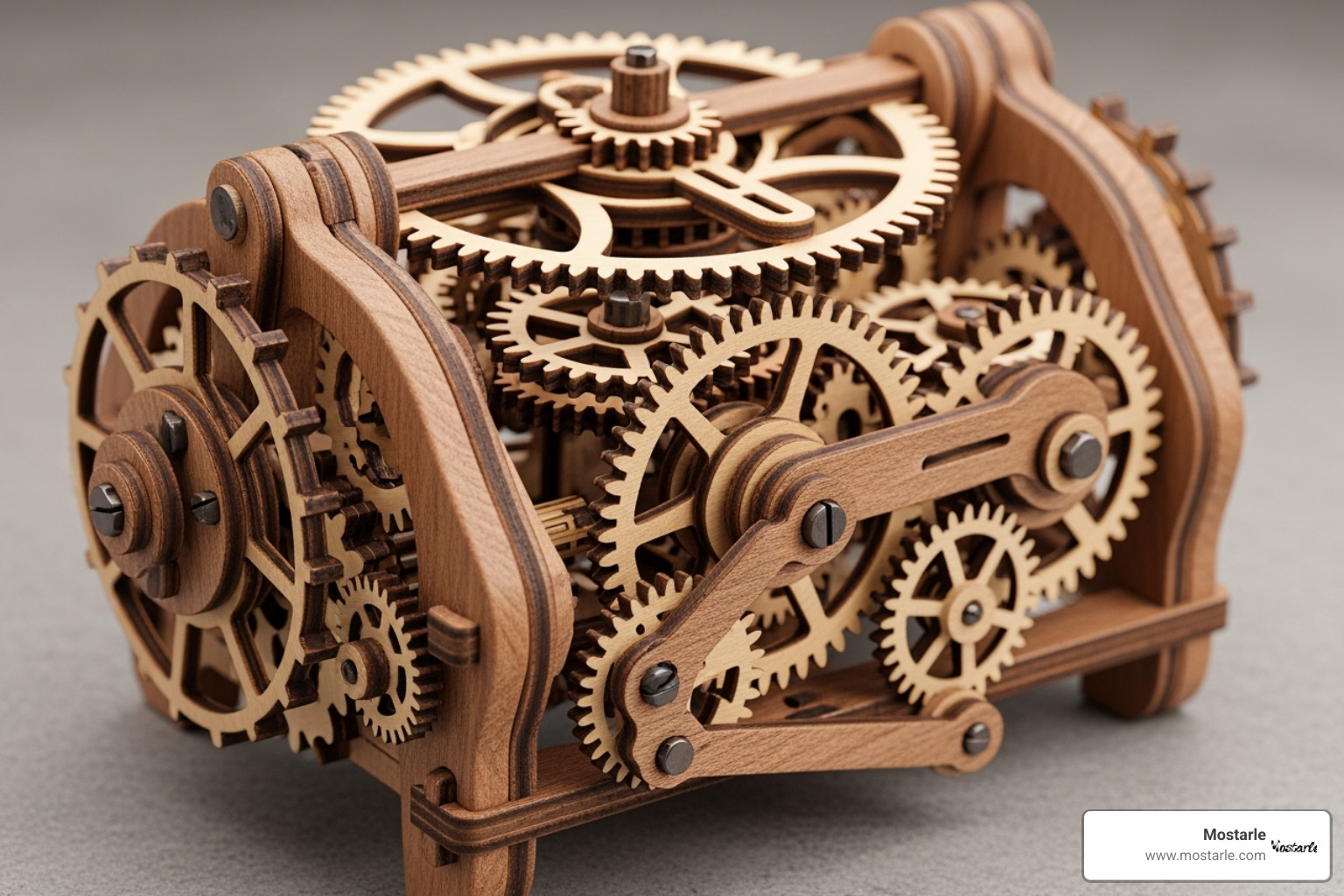
Mechanical gears wooden puzzles combine the timeless appeal of woodworking with the fascinating world of moving parts. These aren't your typical jigsaw puzzles - they're intricate 3D models that come alive with spinning gears, rotating mechanisms, and mesmerizing motion once assembled.
What makes these puzzles special:
- Precision engineering - Laser-cut pieces fit together with 0.05mm accuracy
- No glue required - Parts interlock naturally using traditional joinery
- Educational value - Teach real physics and engineering principles
- Dual purpose - Function as both puzzle and decorative kinetic art
- Range of complexity - From 15-piece beginner models to 978-piece masterpieces
- Price accessibility - Models available from $20 to $139
The magic happens when you turn that first gear and watch the entire mechanism spring to life. What started as flat wooden sheets transforms into a working clock, spinning globe, or marble run that demonstrates real mechanical principles.
These puzzles trace their roots back to the Industrial Revolution, when gear transmission became widespread across Europe in the 18th century. Today's versions use CO2 laser-cutting technology to achieve the precision that makes smooth gear operation possible - something that would have amazed those early mechanical engineers.
Whether you're drawn to the meditative focus of assembly, the satisfaction of understanding how gears transfer motion, or simply want a unique piece of kinetic art for your space, mechanical gears wooden puzzles offer something far beyond ordinary entertainment.
The Gears of Time: A Brief History of Mechanical Marvels
Every great story has humble beginnings, and mechanical gears wooden puzzles are no exception. Picture this: back in the 1760s, a mapmaker named John Spilsbury had a brilliant idea. He took a map, mounted it on wood, and cut it into pieces to help children learn geography. Little did he know he was creating the very first jigsaw puzzle!
Those early puzzles were flat and simple - nothing like the intricate moving masterpieces we see today. But they planted a seed that would grow into something extraordinary.
The Great Depression of the 1930s marked a turning point for wooden puzzles. When money was tight and entertainment options were limited, families finded these affordable treasures offered hours of engaging fun. It's heartwarming to think that even during such challenging times, people found joy in the simple act of fitting pieces together.
But here's where things get really interesting. The true ancestors of today's mechanical gears wooden puzzles trace back to the Industrial Revolution. During the 18th century, gear transmission became widespread across Europe, changing how machines worked. Those spinning, clicking gears that once powered massive factory equipment have found their way into our homes as delightful wooden models.
The evolution has been remarkable - from simple tools to complex automata. What started as basic mechanical devices in workshops has blossomed into the sophisticated puzzle designs that captivate us today. If you're curious about the broader puzzle story, you'll find A look at puzzle history fascinating reading.
The Modern Renaissance of Wooden Puzzles
The leap from those early flat puzzles to today's moving mechanical marvels didn't happen overnight. The game-changer was laser-cutting technology - particularly precise CO2 lasers that can cut with incredible accuracy.
This technological breakthrough sparked a rise of hobbyist kits that would have been impossible to create by hand. Suddenly, intricate gears that once required master craftsmen could be precisely cut and made available to anyone with patience and curiosity.
The shift to complex mechanical designs has been nothing short of revolutionary. We've moved from static pictures to dynamic sculptures that actually work. Gears turn, pendulums swing, and music boxes play - all assembled from flat wooden sheets.
Perhaps most exciting of all is the global community of builders that has emerged. People from all corners of the world now share their assembly experiences, troubleshooting tips, and the pure joy of watching their wooden creations come to life. It's a testament to how innovation can breathe new life into timeless human pleasures.
Anatomy of a Marvel: What Makes Mechanical Gears Wooden Puzzles Tick?
Have you ever wondered what makes those mechanical gears wooden puzzles operate so smoothly? The secret lies in an incredible marriage of traditional craftsmanship and cutting-edge technology that would have amazed woodworkers from centuries past.
The foundation starts with the material itself - high-grade, 100% natural plywood carefully selected for its stability and workability. But here's where things get really exciting: modern manufacturers use CO2 laser technology to achieve something that seems almost magical. We're talking about precision that controls errors within an astonishing 0.05mm. To put that in perspective, that's thinner than a human hair!
This microscopic accuracy is what makes all the difference between a puzzle that works beautifully and one that frustrates you to no end. Every gear tooth, every peg, and every interlocking part fits together like pieces of a perfectly choreographed dance. Without this precision, gears would bind up, mechanisms would jam, and your beautiful model would become an expensive paperweight.
But perhaps the most satisfying aspect is the no-glue assembly. Thanks to that laser precision, pieces are designed to interlock naturally using traditional joinery techniques adapted for modern cutting. You can focus entirely on the joy of building and understanding how things work, rather than wrestling with messy adhesives or waiting for glue to dry. It's engineering elegance at its finest, proving that sometimes the old ways really are the best ways.
Understanding the Core Mechanisms
When you're assembling mechanical gears wooden puzzles, you're not just putting pieces together - you're building miniature machines that demonstrate the same principles that power everything from windmills to race cars. Let's explore the fascinating mechanisms that bring these models to life.
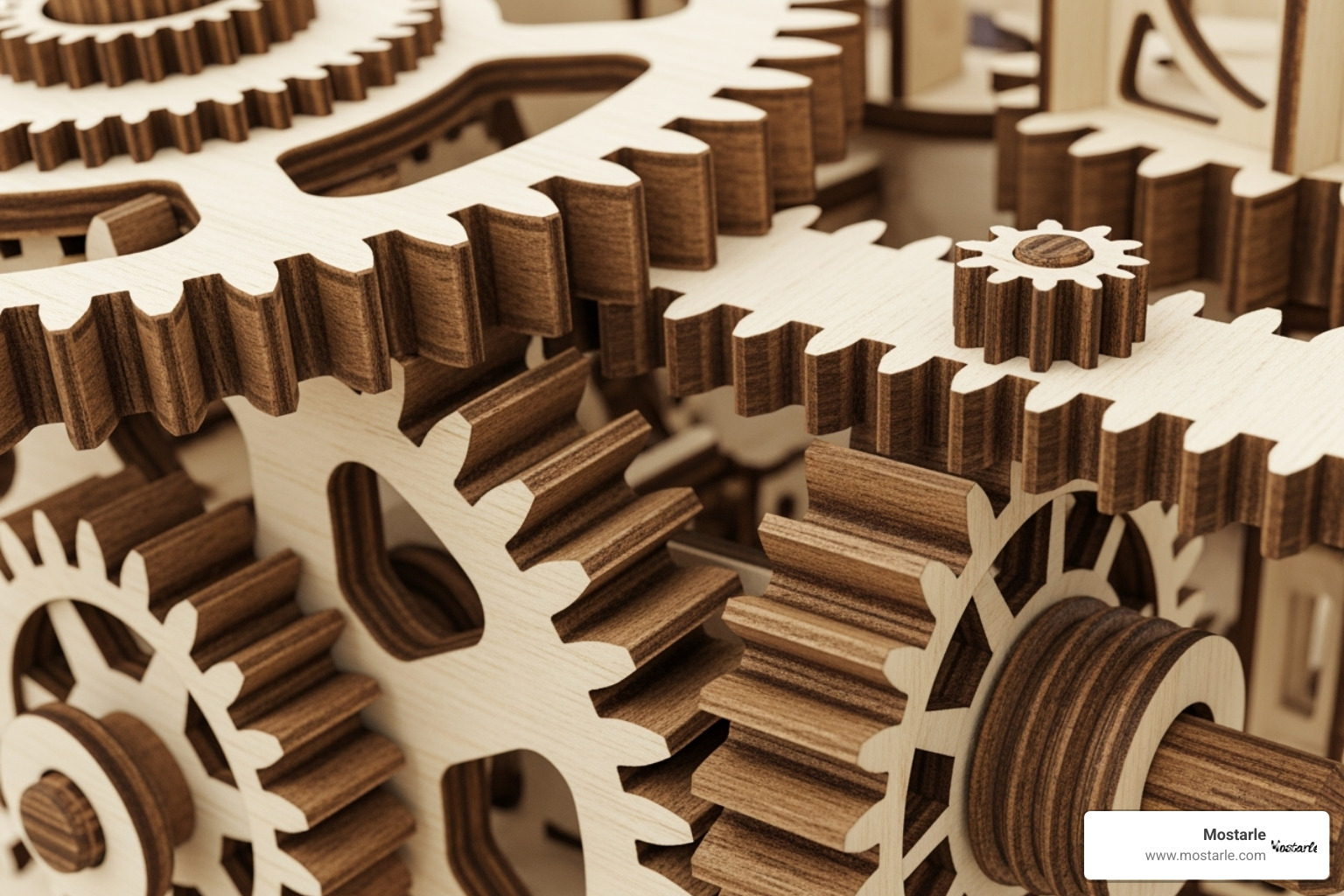
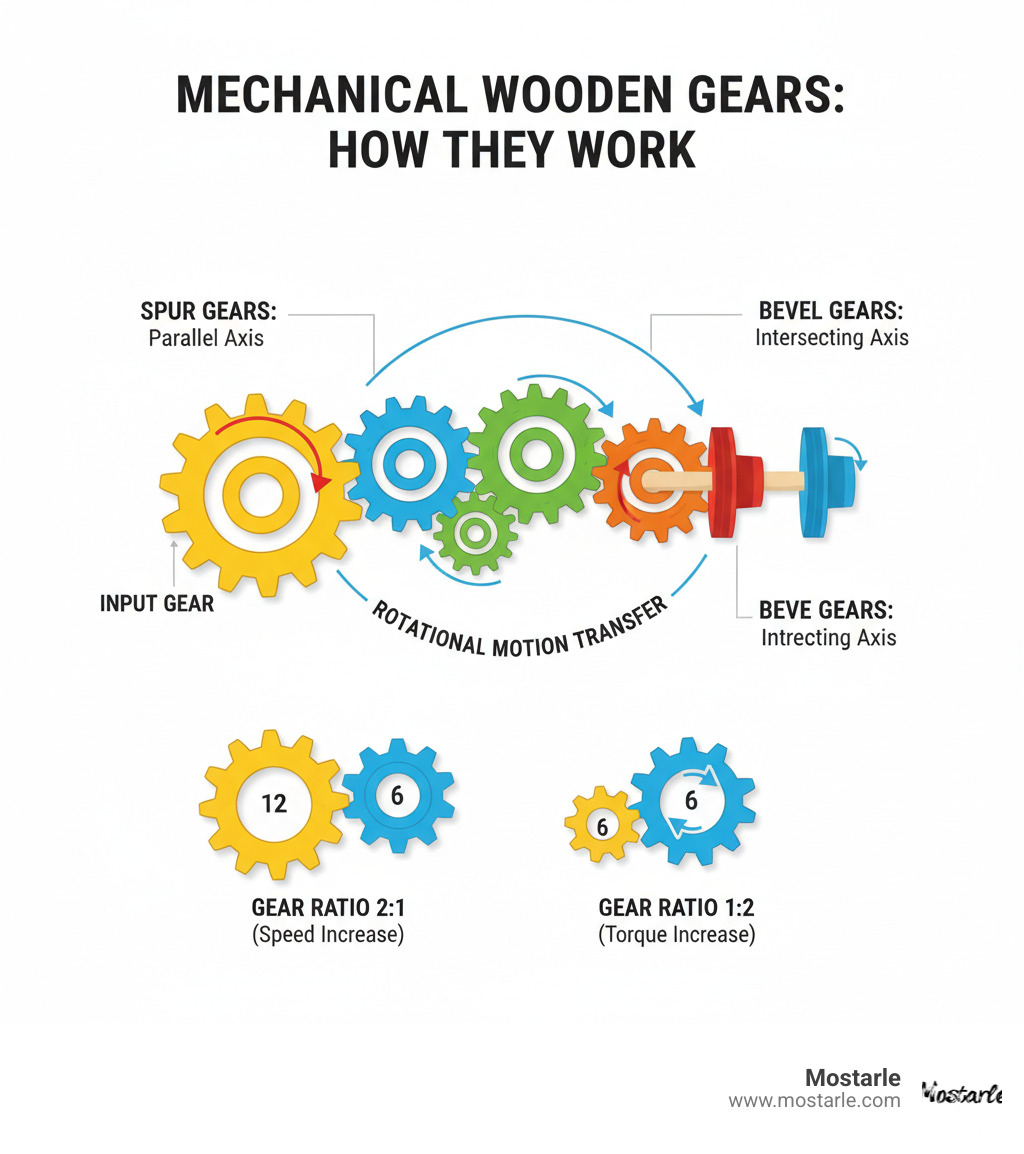
Spur gears are the workhorses you'll encounter most often. These circular gears with straight teeth are the backbone of almost every mechanical puzzle, driving clock hands, powering marble lifts, and transferring motion throughout the entire system. They're simple in concept but essential in function.
Bevel gears add a twist - literally. Unlike their flat cousins, these cone-shaped gears can change the direction of motion, often at perfect right angles. You'll find them in wooden vehicle models where the steering needs to turn, or in mill designs where power flows from horizontal to vertical shafts.
The Geneva drive creates one of the most satisfying movements in mechanical puzzles. This clever mechanism transforms smooth, continuous rotation into precise stop-and-go motion. Watch it work once, and you'll understand why clockmakers and film projector designers fell in love with this ingenious solution.
Pendulum escapements represent centuries of human ingenuity compressed into wooden form. These mechanisms are the heartbeat of any clock model, releasing energy in perfectly timed intervals to keep accurate time. Building one connects you directly to the master clockmakers of history.
Some advanced models feature rubber-band motors that store energy when wound up, then release it to power the entire mechanism autonomously. It's like having a tiny engine that demonstrates the principles of potential and kinetic energy right on your desk.
For those ready to dive deeper into these fascinating mechanisms, exploring complex mechanisms in Mostarle puzzles offers an in-depth look at how these principles come together in beautifully crafted models.
The Educational Value of Assembling Mechanical Gears Wooden Puzzles
Building mechanical gears wooden puzzles transforms abstract physics concepts into tangible, hands-on learning experiences. These aren't just entertaining pastimes - they're interactive classrooms that make STEM learning both fun and memorable.
As you assemble each model, physics principles come alive before your eyes. Gear ratios stop being mysterious math problems and become clear visual demonstrations of how small gears spin fast while large gears provide power. You'll see power transmission in action as energy flows from one component to another, making concepts like leverage, friction, and energy conversion feel natural and intuitive.
The engineering concepts you encounter go far beyond basic mechanics. Following detailed instructions develops systematic thinking. Troubleshooting when pieces don't quite fit teaches problem-solving. Understanding how each component contributes to the whole system builds foundational knowledge that applies to everything from bicycle repair to rocket science.
For young minds, these hands-on experiences can spark lifelong interests in engineering and design. For adults, they offer a wonderful way to reconnect with scientific principles in a relaxed, enjoyable setting. There's something deeply satisfying about understanding exactly how the mechanisms around us actually work.
The beauty lies in learning through doing rather than memorizing. When you turn that first gear and watch your completed model spring to life, you're not just seeing the result - you're understanding the why behind every movement. For a comprehensive exploration of how these puzzles improve learning, everything to know about mechanical puzzles provides valuable insights into their educational impact.
More Than a Hobby: The Cognitive and Creative Benefits
There's something magical that happens when we sit down with a mechanical gears wooden puzzles spread out before us. The world seems to quiet down, our focus sharpens, and suddenly we're not just assembling pieces – we're giving our minds a wonderful workout.

Every piece we pick up presents a little puzzle within the bigger puzzle. We find ourselves naturally developing problem-solving skills as we figure out where each gear belongs and how the mechanisms will work together. It's like being a detective, looking for clues in the shape of a wooden cog or the angle of a connecting piece.
The spatial reasoning benefits are equally impressive. We're constantly rotating pieces in our minds, imagining how flat wooden sheets will transform into spinning globes or ticking clocks. This mental gymnastics strengthens our ability to visualize and manipulate objects in three dimensions – a skill that serves us well far beyond puzzle building.
Our hands get their own gentle workout too. The precise movements needed to align tiny gear teeth and fit delicate pieces together give our fine motor skills valuable practice. There's a satisfying precision required that keeps both our minds and fingers engaged.
For adults, this kind of focused mental activity supports cognitive development and may even help keep our minds sharp as we age. But perhaps more immediately, many of us find the profound stress relief that comes from this focused concentration. When we're puzzling over how a pendulum escapement works, our everyday worries tend to fade into the background.
The rhythmic nature of assembly – examining pieces, testing fits, making connections – creates an almost meditative state. It's no wonder that so many people find genuine peace in the process. As we explore in The healing power of mechanical puzzles, there's real therapeutic value in engaging with these intricate creations.
From Assembly to Artistry
The journey doesn't end when we place the final piece. Our completed mechanical gears wooden puzzles transform from construction projects into stunning decorative items and mesmerizing kinetic sculptures. A wooden clock doesn't just tell time – it becomes a conversation piece that draws visitors' eyes and sparks curiosity about how those gears work together.
These aren't static display pieces either. They invite creative play in the most delightful ways. A marble run becomes an endless source of entertainment as we watch tiny spheres steer their wooden pathways. A music box fills our space with gentle melodies while its gears turn in perfect harmony.
For families, these completed puzzles often become storytelling prompts. Children create adventures around their mechanical creations, imagining the stories of clockwork characters or the journeys of marbles through elaborate runs. The moving parts seem to bring these wooden worlds to life.
Many models offer even more creative possibilities as paintable models. We can add our own artistic touch, choosing colors that match our decor or simply express our personality. The natural wood provides a perfect canvas for customization, allowing each builder to create something truly unique.
From those first flat wooden sheets to a fully functional, beautifully decorated mechanical marvel – the change represents far more than assembly. It's a testament to the wonderful blend of engineering precision and artistic expression that makes these puzzles so captivating.
A Guide to Popular Puzzle Types and Themes
The world of mechanical gears wooden puzzles offers an incredible variety of models that can capture anyone's imagination. Whether you're drawn to the mesmerizing flow of marbles or the precise tick of a handcrafted clock, there's likely a perfect puzzle waiting for you.

Marble runs are among the most captivating designs, featuring elaborate tracks and lifting mechanisms that guide marbles through enchanting journeys. These models often showcase complex gear systems that power elevators and switches, creating an almost hypnotic display of mechanical precision.
Clock models bring timekeeping to life in the most literal sense. From charming desk pieces to neat wall-mounted timepieces like the Owl Clock, these puzzles demonstrate the intricate escapements and gear trains that have kept accurate time for centuries. There's something deeply satisfying about building your own working timepiece from scratch.
Music boxes add a delightful auditory dimension to the mechanical experience. Models like the Magic Cello don't just move - they play beautiful melodies, combining the visual appeal of spinning gears with the joy of music. It's like assembling your own miniature orchestra.
Globe puzzles transform geography into kinetic art. The Luminous Globe is particularly striking, featuring internal mechanisms that allow rotation and even illumination. These models make wonderful conversation pieces that blend education with decoration.
Vehicle models tap into our fascination with transportation. The Grand Prix Car offers a nostalgic building experience, complete with movable parts that bring these miniature machines to life. There's something universally appealing about crafting your own vintage automobile.
Automata and demonstrators are the scientists of the puzzle world. Models like the Mechanical Orrery showcase celestial mechanics through sophisticated gear systems, while modular designs allow endless configurations to demonstrate various mechanical principles like Geneva wheels and linkages.
Vintage-inspired machines offer a delightful trip through mechanical history. From classic gramophones to movie projectors and perpetual calendars, these designs celebrate the ingenuity of past inventors while giving us hands-on experience with their creations.
Choosing Your First Mechanical Gears Wooden Puzzles
Starting your journey with mechanical gears wooden puzzles doesn't have to feel overwhelming. The key is matching your first puzzle to your experience level and what you hope to accomplish.
Most puzzles fall into three main categories: easy models with 15-150 pieces that take 1-3 hours to complete, medium complexity builds with 150-400 pieces requiring 3-8 hours, and high difficulty masterpieces with 400+ pieces that might take multiple sessions to finish.
Beginner-friendly puzzles typically feature simple mechanisms and fewer moving parts. They're perfect for getting familiar with how wooden gears work together without getting frustrated. These usually cost between $20-$40 and offer basic movement with decorative appeal.
Intermediate models step things up with interconnected mechanisms and more intricate gear trains. Many include special features like music boxes or simple lighting effects. Expect to invest $40-$80 and 3-8 hours of focused building time.
Advanced puzzles are for those who love a serious challenge. These complex builds often feature multiple functional systems, delicate assembly requirements, and impressive features like battery-powered components, wall-mounting capabilities, or elaborate lighting systems. They typically cost $80 and up, reflecting their sophisticated engineering.
When choosing your first puzzle, consider what draws you most. Do you want something movable that you can interact with daily? Are you interested in music features that add sound to the experience? Would lighted elements make your completed puzzle more impressive as a display piece?
The beauty of these puzzles lies in their precision manufacturing. Modern laser-cutting technology ensures pieces fit together smoothly, with some manufacturers achieving incredible 0.05mm accuracy. This precision means you can focus on the joy of assembly rather than struggling with poorly fitting parts.
There's no rush to tackle the most complex model right away. Starting with a simpler design helps you understand the basics of gear operation and assembly techniques. Once you've experienced that magical moment when you turn the first gear and watch your creation come to life, you'll likely find yourself ready for bigger challenges.
Frequently Asked Questions about Mechanical Wooden Puzzles
When people find the fascinating world of mechanical gears wooden puzzles, they naturally have questions. We've been helping builders steer these intricate models for years, and certain questions come up time and again. Let's explore the most common ones.
How does laser-cutting improve wooden puzzle quality?
The difference between traditional cutting methods and modern laser technology is like comparing a butter knife to a surgeon's scalpel. When we use CO2 laser-cutting technology, we're talking about precision that achieves error control within just 0.05mm - that's thinner than a human hair!
This incredible accuracy creates a precision fit that makes assembly feel almost magical. Each gear tooth slides into place exactly as intended, without forcing or struggling. The gears themselves operate with smooth, fluid motion because every edge is perfectly shaped and clean.
What really sets laser-cutting apart is how it eliminates common frustrations. There's no splintering because the laser vaporizes the wood rather than tearing through it. This means safer handling and cleaner assembly. The reduced friction between moving parts is crucial - imagine trying to operate a delicate clock mechanism with rough, imprecise gears. It simply wouldn't work.
All of this precision translates to easier assembly overall. Instead of wrestling with ill-fitting pieces, you can focus on understanding how the mechanisms work and enjoying the building process. It's the difference between a frustrating afternoon and a genuinely rewarding experience.
What are the price ranges for these puzzles?
Mechanical gears wooden puzzles span a wide price range, reflecting everything from simple starter models to engineering marvels with hundreds of pieces. Think of it like choosing a musical instrument - you can start with something basic or invest in a masterpiece.
Beginner models typically fall in the $20-$40 range. These are perfect for testing the waters or introducing someone to the hobby. They might have 50-150 pieces and simple mechanisms that still demonstrate basic engineering principles.
Intermediate models occupy the $40-$80 bracket and offer significantly more complexity. Here you'll find models with multiple gear systems, perhaps a music box component, or more intricate automata. The piece count usually jumps to 200-400 pieces, requiring several focused sessions to complete.
Advanced models start at $80 and can reach $139 or more. These are the showstoppers - models with 400-978 pieces that might include lighting systems, complex musical mechanisms, or multiple interconnected functions. Building one of these is like constructing a small mechanical symphony.
The price reflects several factors: the complexity of the engineering, the piece count, whether it includes special features like lights or electronic components, and the overall size of the finished model. A simple gear demonstrator costs much less than a fully functional orrery that shows planetary movements.
What if I lose or break a part during assembly?
Don't panic - it happens to even the most careful builders! That tiny gear that just rolled under the couch or the delicate piece that snapped despite your best efforts isn't the end of your project.
Most reputable manufacturers understand that part replacement is part of good customer service. The process is usually straightforward: contact their support team with your proof of purchase and the specific part number from your instruction manual. Many companies provide replacements free of charge or for just the cost of shipping.
Manufacturer support goes beyond just replacement parts. Good companies have knowledgeable teams who can help troubleshoot assembly issues, clarify confusing instruction steps, or suggest workarounds for common problems.
The community of builders around these puzzles is incredibly helpful too. Online forums and social media groups are filled with experienced enthusiasts who love sharing tips, tricks, and sometimes even spare parts. It's like having a workshop full of friendly neighbors ready to lend a hand.
For minor breaks, DIY fixes are often possible. A dab of wood glue can repair a small crack, and sometimes you can fashion a replacement from leftover wood pieces. These little repairs can actually add to the satisfaction of completing your model.
Our advice? Keep your original packaging and instruction manual until your puzzle is completely assembled and working perfectly. This information is usually essential for requesting any replacement parts you might need.
Conclusion
Our journey through mechanical gears wooden puzzles has revealed something truly special. These aren't just puzzles - they're gateways to understanding, creativity, and the simple joy of making something work with our own hands.
We've explored how these remarkable creations blend centuries of mechanical tradition with modern precision manufacturing. From the Industrial Revolution's gear systems to today's laser-cut masterpieces, each puzzle carries forward a legacy of human ingenuity. The educational value alone is remarkable - watching abstract physics concepts come alive as gears mesh and mechanisms dance is something textbooks simply can't match.
But perhaps what strikes us most is the deeper satisfaction these puzzles provide. There's something profoundly rewarding about the tangible connection we form with mechanical objects. In our digital world, the experience of physically assembling moving parts, feeling the smooth operation of perfectly cut gears, and watching our creation spring to life feels almost magical.
The cognitive benefits we gain - sharper problem-solving skills, improved spatial reasoning, and that wonderful sense of calm focus - make these puzzles far more than entertainment. They're tools for growth, stress relief, and creative expression all rolled into one beautiful wooden package.
At Mostarle, we understand this philosophy of finding art in mechanical objects. Just as we transform everyday nuts and bolts into extraordinary creations, mechanical gears wooden puzzles prove that ordinary materials can become something remarkable through thoughtful design and human creativity. They embody our belief that there are no limits to what we can create when we combine imagination with craftsmanship.
Whether you choose a simple beginner model or tackle an advanced 978-piece masterpiece, you're starting on more than just assembly - you're connecting with generations of makers, thinkers, and dreamers who found wonder in the dance of gears and the satisfaction of creation.
The joy of creation awaits. Your next mechanical marvel is just waiting for your touch.
Find more about the fascinating world of mechanical puzzles