Expert Support

Feeling Blue? Meet the Electric Metallic Blue Jumping Spider
The Tiny Spider That Stops You in Your Tracks
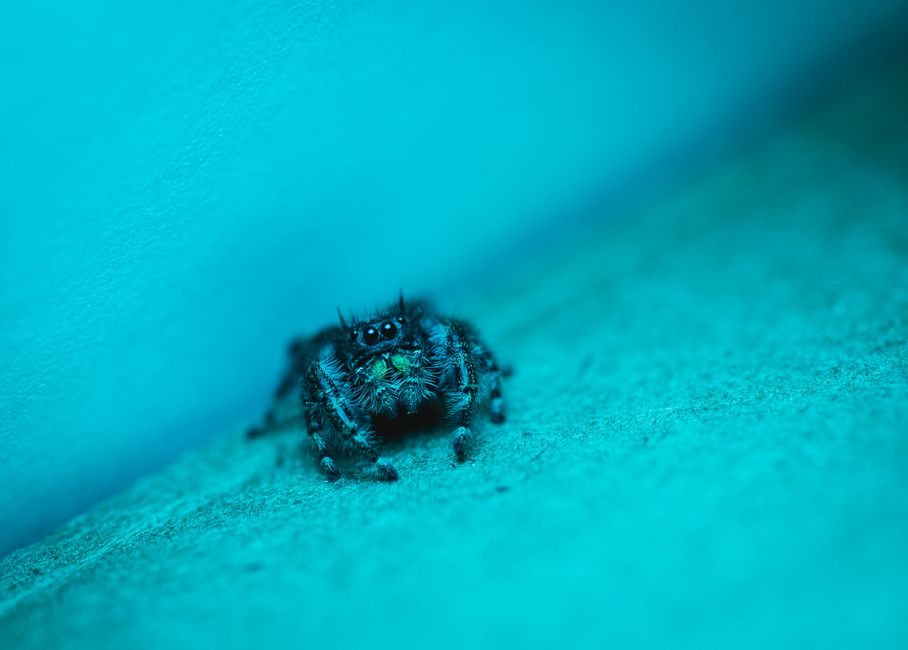
The metallic blue jumping spider is one of nature's most visually stunning small creatures — a jewel-toned arachnid that seems almost too vivid to be real.
Quick answer: What is the metallic blue jumping spider?
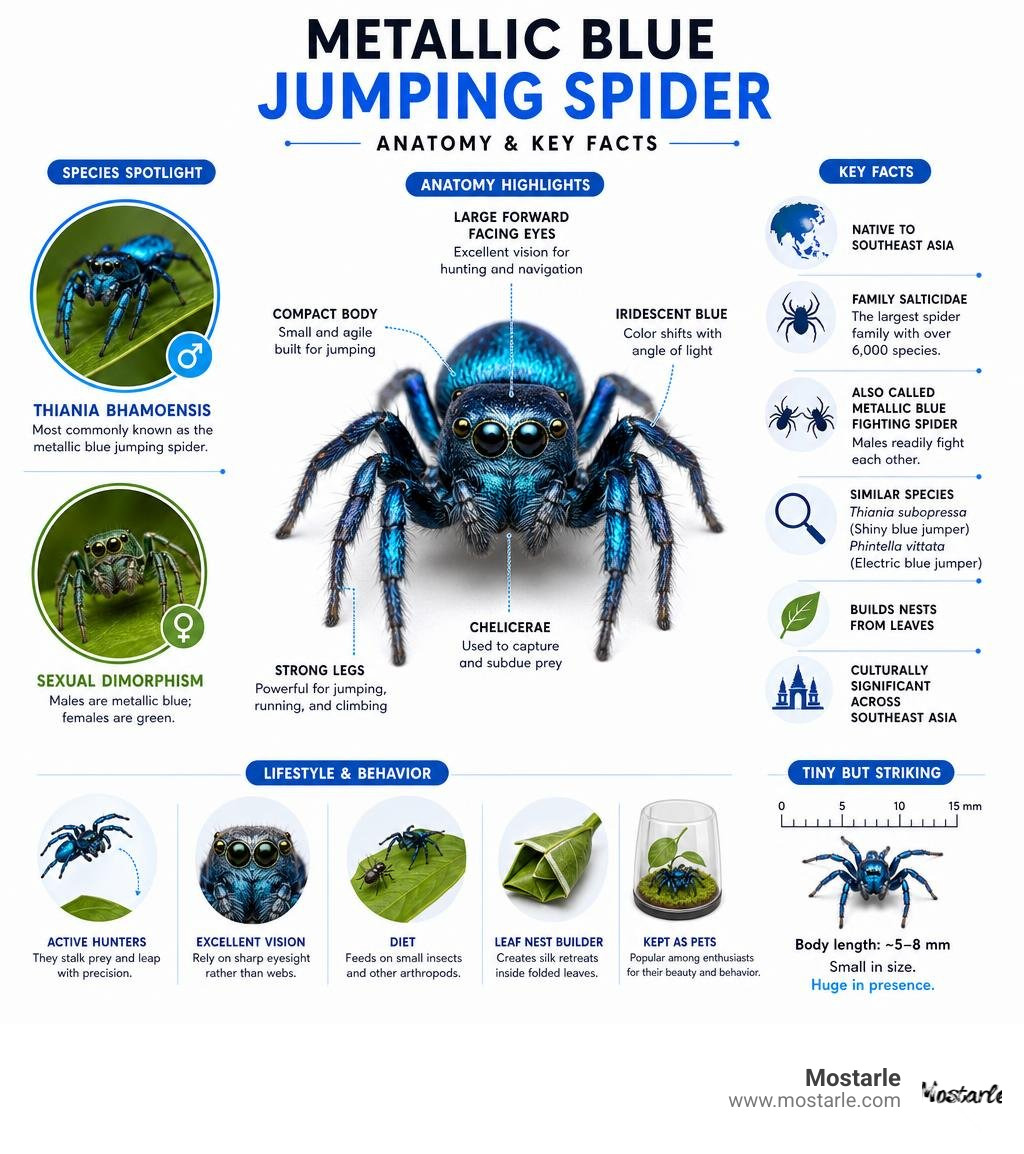
- It most commonly refers to Thiania bhamoensis, a small jumping spider native to Southeast Asia
- Males are a striking iridescent blue; females lean more green
- It belongs to the family Salticidae — the largest spider family, with over 6,000 species
- It is also called the metallic blue fighting spider, because males readily fight each other
- Similar-looking species include Thiania subopressa (shiny blue jumper) and Phintella vittata (electric blue jumper)
- It is kept as a pet, builds nests from leaves, and is culturally significant across Southeast Asia
These spiders are tiny — but their color stops people mid-step. The iridescence shifts from green to blue depending on the angle of light, almost like a living gemstone.
They are active, visual hunters with sharp eyesight. Unlike most spiders, they don't spin webs to catch prey. They stalk it, then leap.
If you've spotted a small, brilliantly blue spider and wanted to know what it was — you're in the right place.
What is the Metallic Blue Jumping Spider?
When people search for the metallic blue jumping spider, they are almost always looking for Thiania bhamoensis. This remarkable species is a member of the Salticidae family, which we know and love for their expressive eyes and incredible jumping abilities. To understand these creatures better, you can explore our guide on Getting to Know the Jumping Spiders.
In the wild, Thiania bhamoensis is native to a broad stretch of Southeast Asia, ranging from Myanmar (formerly Burma) all the way down to Sumatra, Java, and Singapore. They are strictly arboreal, spending their lives high up in the foliage of tropical plants.
According to the official Thiania bhamoensis - Wikipedia page, the genus Thiania has expanded over the years to include dozens of distinct species, but Thiania bhamoensis remains the absolute superstar of the group due to its jaw-dropping coloration and unique cultural history.
Distinguishing the Metallic Blue Jumping Spider from Similar Species
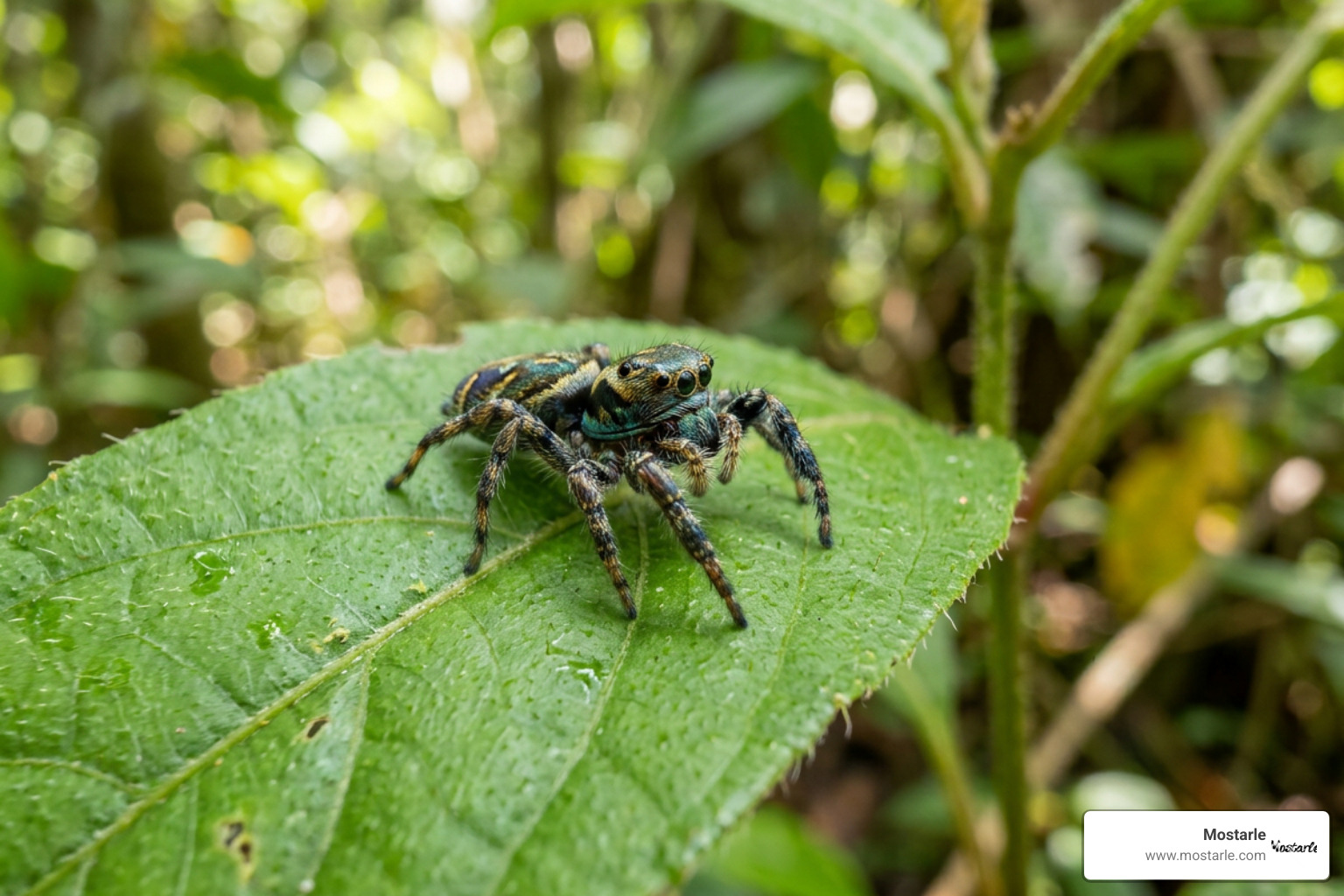
Because "metallic blue" is a popular look in the spider world, Thiania bhamoensis is frequently confused with a few of its close relatives and neighbors. If you are trying to identify a shiny blue arachnid, it helps to know who is who:
- Thiania subopressa (Shiny Blue Jumping Spider): This close cousin is slightly smaller, with adults measuring only about 0.5 to 0.6 cm in body length. They are incredibly fierce, active, and known to be highly aggressive, sometimes even cannibalizing weaker spiders. You can find them imported through specialty shops like the Shiny blue jumping spider(Thiania subopressa) for Sale page.
- Phintella vittata (Electric Blue Jumper): This tiny ornamental jumper is widespread across Singapore, India, and parts of China. It features alternating bands of glossy black and electric blue-green. Unlike typical members of its genus, the male lacks the white patches of hair on its head. You can read more about its taxonomy on the "Phintella" vittata (C. L. Koch, 1846) - Electric Blue Jumper - SpiderNet page.
- Phintella lepidus (Lobster Claw Tiny Metallic Jumper): Found in the mature forests of China and Singapore, this species is named for the male's unique lobster-claw-shaped reproductive organs. It is tiny (around 4 mm) and highly metallic. Check out its scientific description on the "Phintella" lepidus Cao & Li, 2016 - Lobster Claw Tiny Metallic Jumper - SpiderNet page.
To make identification easier, we have put together a quick comparison table:
| Species | Common Name | Average Body Size | Key Visual Identifier | Primary Location |
|---|---|---|---|---|
| Thiania bhamoensis | Metallic Blue Jumping Spider | 0.8 to 1.2 cm | Solid iridescent blue (males) or green-blue (females) | Myanmar to Sumatra, Singapore |
| Thiania subopressa | Shiny Blue Jumping Spider | 0.5 to 0.6 cm | Brilliantly shiny, compact body, aggressive posture | China, Southeast Asia |
| Phintella vittata | Electric Blue Jumper | 0.3 to 0.5 cm | Alternating electric blue and black stripes | India, Singapore, Vietnam |
| Phintella lepidus | Lobster Claw Metallic Jumper | 0.4 cm | Highly metallic, male has lobster-claw-shaped palps | China, Singapore |
Physical Characteristics, Behavior, and Habitat
What makes the metallic blue jumping spider so mesmerizing is its physical makeup. Their bodies are covered in specialized, quasi-periodic perforated nanostructures. Instead of relying on chemical pigments for color, these microscopic structures reflect specific wavelengths of light. This means their blue and green hues are entirely structural. Under different angles of light, they shift from deep sapphire to emerald green or even royal purple. For a deep dive into how these visual dynamics work across different species, check out our Shiny Jumping Spider Complete Guide.
Sexual Dimorphism: Blue vs. Green
There is a clear visual divide between the sexes:
- Males: Display a deep, brilliant metallic blue across their bodies. When viewed from the front, their faces are bright white, framed by their large, curious eyes.
- Females: Lean much more toward an iridescent green or teal. From the front, their faces appear dark brown or black, giving them a completely different look.
The Leaf-Rivet Nesting Behavior
Perhaps the most astonishing behavior of Thiania bhamoensis is how they build their homes. While most jumping spiders spin simple silk sacs under bark or rocks, this species is an architect. They prefer to live on the Crinum asiaticum (commonly known as the giant spider lily).
To build a nest, the spider finds two overlapping green leaves. It then spins thick silk "rivets" to bind the leaves together, creating a private, weatherproof pocket. Making a single silk rivet takes about half an hour of continuous, precise work. A complete nest usually requires anywhere from four to ten rivets arranged in a neat, elliptical pattern. Both adults and juveniles build these leaf-nests to sleep in, molt, and lay their eggs.
According to the Metallic Blue Jumper (Thiania bhamoensis) - Bali Wildlife database, their egg sacs are white, flat, and can be two to three times the size of the mother spider, safely tucked away inside these leaf-rivet fortresses.
Anatomy and Size of the Metallic Blue Jumping Spider
When discussing the physical dimensions of these spiders, we run into a very common mix-up in the exotic pet community. True jumping spiders of the Salticidae family—including Thiania bhamoensis—are small, typically reaching a body length of about 1 centimeter (less than half an inch).
However, because of the name "metallic blue," they are sometimes confused with the famous blue tarantula, Poecilotheria metallica (also known as the Gooty sapphire ornamental tarantula).
To keep the facts straight, let's look at how these two very different blue arachnids compare:
-
The True Metallic Blue Jumper (Thiania bhamoensis):
- Body Size: 0.8 to 1.2 cm.
- Lifespan: Typically 1 to 2 years in captivity.
- Behavior: Diurnal, active visual hunter, harmless to humans.
-
The Blue Tarantula (Poecilotheria metallica):
- Leg Span: Adult females can reach a massive leg span of 15–20 cm.
- Lifespan: Females typically live for 11 to 12 years (sometimes up to 15 years), while males live for 3 to 4 years.
- Behavior: Nocturnal, arboreal funnel-web builder, possesses medically significant venom.
If you want to understand the structural and behavioral differences between these two families of arachnids, our article Tarantulas and Jumping Spiders: Understanding the Difference offers an excellent, easy-to-read breakdown.
Captive Care, Market Pricing, and Conservation
Because of their dazzling colors and active personalities, the metallic blue jumping spider has become highly sought after in the exotic pet trade. However, keeping them requires a specific setup to keep them healthy and active.
Enclosure and Environmental Requirements
To mimic their tropical rainforest homes, you need to pay close attention to temperature and humidity:
- Enclosure: A tall, vertically oriented acrylic enclosure is best. Provide plenty of artificial broad leaves (like fake spider lily leaves) so they can perform their natural leaf-riveting behavior.
- Temperature: Keep the enclosure between 22°C and 29°C (71°F to 84°F).
- Humidity: They require high humidity, ideally between 70% and 85%. Mist one side of the enclosure daily with a fine mister, but avoid leaving large standing water droplets, which can trap and drown tiny spiders.
- Diet: They are active hunters. Feed them small, live insects such as fruit flies (Drosophila hydei), pinhead crickets, or small breadworms. They will not eat dead prey.
Market Pricing and Availability
Due to their restricted natural habitat and the difficulty of breeding them in captivity, Thiania bhamoensis is considered a premium pet.
According to commercial listings on pages like Thiania bhamoensis (Metallic blue jumping spider ... - Scorpo Hunter , pricing varies significantly by life stage and sex:
- Spiderlings (Slings): Usually range from $100 to $200 USD in the United States and Europe.
- Sub-adults & Adults: Can easily exceed $500 USD, especially for highly vibrant, confirmed females or established pairs.
Conservation Concerns
While they are highly popular, we must highlight a major conservation concern. Thiania bhamoensis has a highly restricted distribution. In several regions, they are known to occupy a single, small area of less than 100 square kilometers in highly disturbed reserve forests. Surveys of adjacent forests have failed to locate additional populations, meaning their wild numbers are incredibly vulnerable to habitat loss and over-collection.
When buying, always try to source your spider from reputable breeders who offer captive-bred specimens rather than wild-caught individuals.
Frequently Asked Questions about Metallic Jumping Spiders
Why is Thiania bhamoensis called the fighting spider?
In Southeast Asia, particularly in Singapore and Malaysia, Thiania bhamoensis is widely known as the "fighting spider." This is because males of this species are highly territorial and will readily fight when they encounter another male.
Historically, children and hobbyists would catch these spiders and keep them in small matchboxes, feeding them and keeping them hydrated with a moist leaf or a dab of saliva. During a match, two males are placed on a neutral surface where they engage in complex ritualistic displays. Scientists have identified twelve distinct fighting behaviors, including leg-waving, body-vibrating, and pushing. The spider that successfully drives the other away is declared the winner, sometimes earning the legendary status of "first king." You can read more about the history of these spiders on the Jumping spiders - The Australian Museum website.
How does the metallic blue jumping spider produce its color?
Unlike many animals that get their color from food or pigment, the blue of the metallic blue jumping spider is a structural color.
As documented on the Jumping Spider Metallic 12 observation pages, their bodies are covered in tiny, specialized scales that act like microscopic prisms. These scales reflect light at very specific angles. When the spider moves, the light shifts, causing its body to shimmer between blue, green, and purple. This structural coloration is also thought to play a major role in species recognition and mating rituals, helping females spot the vibrating courtship dances of the males.
What are the care requirements for keeping Thiania bhamoensis as a pet?
Keeping a metallic blue jumping spider healthy requires mimicking a tropical microclimate. You must provide a warm environment (22–29°C) and high humidity (70–85%).
Because they do not build traditional webs to hunt, they need a steady supply of active, live insects like fruit flies or small crickets. It is also vital to provide real or high-quality silk leaves in their enclosure, as they have an instinctual need to rivet leaves together to build their nests. For more general tips on caring for shiny species, you can refer to the Shiny blue jumping spider(Thiania subopressa) for Sale care guidelines.
Conclusion
The metallic blue jumping spider is a true masterpiece of the natural world. From its brilliant structural colors to its complex leaf-riveting architecture and fiery personality, it is easy to see why these tiny creatures captivate scientists and pet hobbyists alike.
Here at Mostarle, we share that exact same fascination with the intricate, small details of the world. We love taking everyday, forgotten pieces of hardware—like ordinary nuts, bolts, and scrap metal—and transforming them into beautiful, lifelike models of spiders and other incredible creatures. It is our way of showing that with a little creativity, even the most industrial materials can capture the delicate wonder of nature.
If you want to continue your journey into the marvelous world of these tiny eight-legged acrobats, head over to our comprehensive guide on Getting to Know the Jumping Spiders to learn more about their eyesight, hunting habits, and incredible diversity!