


Beyond the Box: Discovering the World of ROKR and UGears 3D Puzzles
Why 3D Wooden Mechanical Puzzles Captivate Builders Worldwide
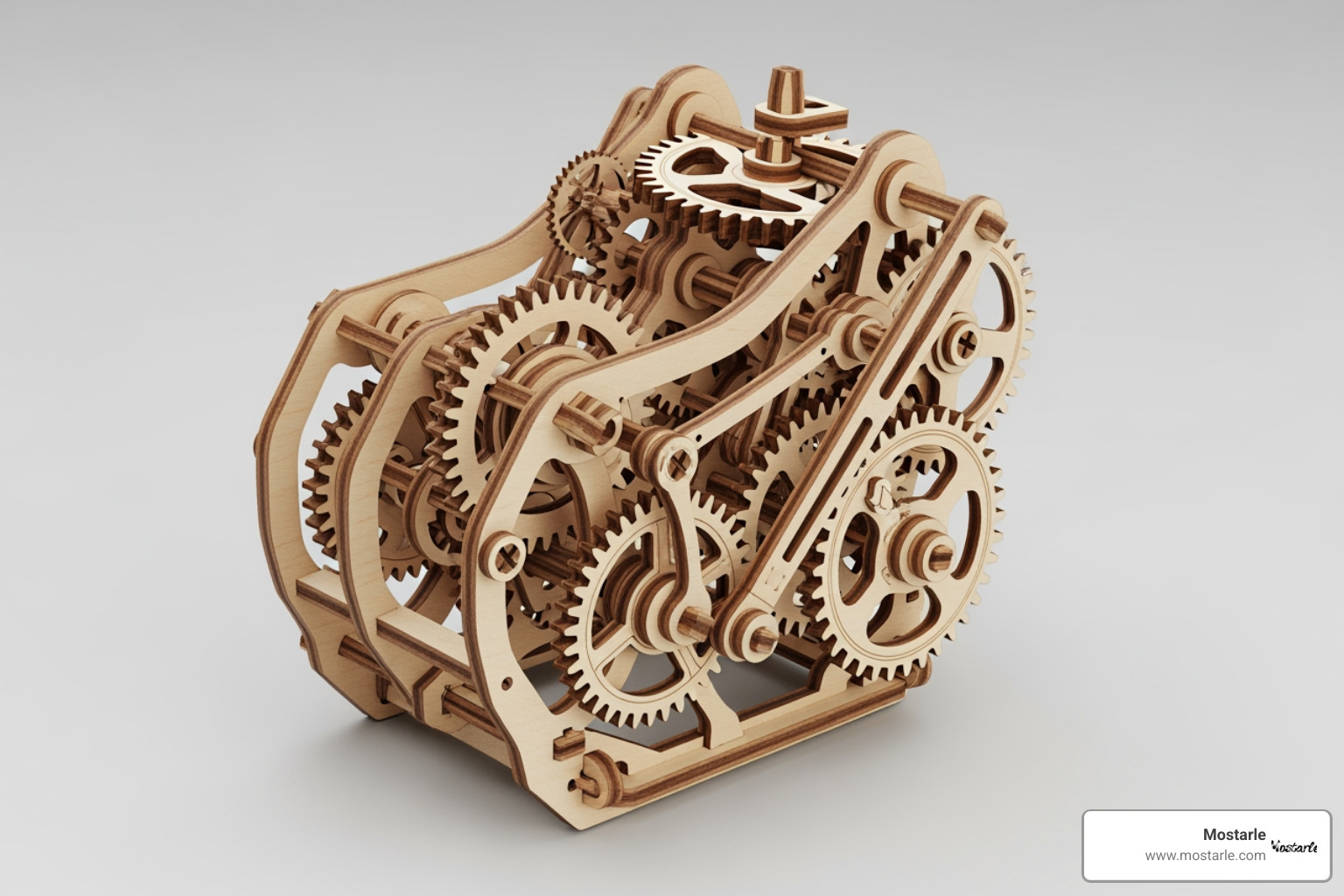
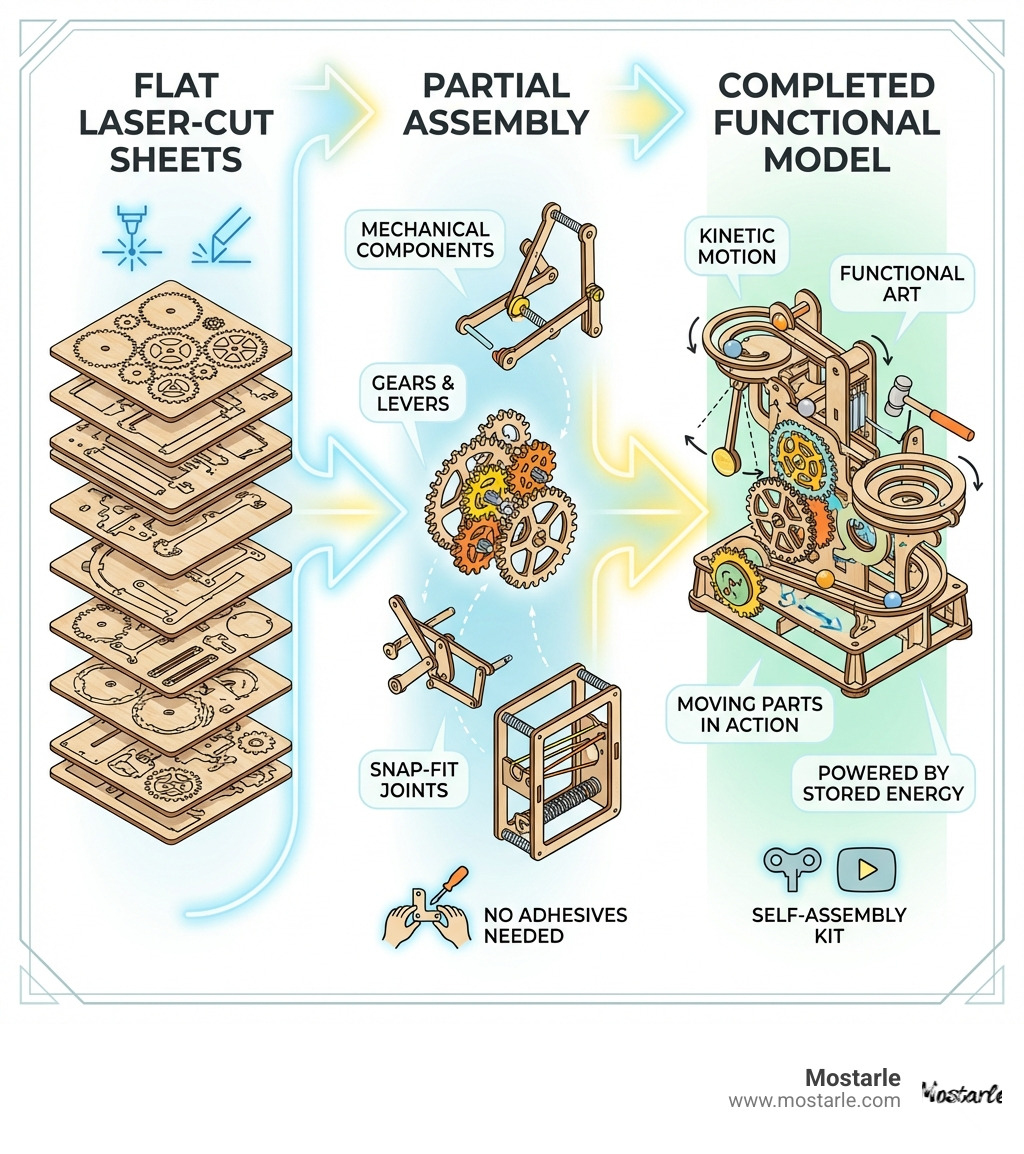
3d wooden mechanical puzzles are self-assembly model kits made from laser-cut plywood that transform flat wooden sheets into intricate, moving sculptures. Unlike traditional jigsaw puzzles, these models feature functional mechanical components—gears, levers, rubber-band motors—that bring your creation to life without batteries or glue.
Quick Overview:
- What they are: DIY wooden model kits with moving mechanical parts
- How they work: Precision-cut pieces snap together; gears and springs create motion
- Popular types: Clocks, vehicles, music boxes, marble runs, steampunk contraptions
- Piece counts: Range from 15 to over 1,200 pieces
- Assembly time: 1-16+ hours depending on complexity
- Price range: $2 to $139 USD
- Recommended age: 14+ (younger with adult supervision)
These aren't just puzzles—they're kinetic art pieces that blend craftsmanship with engineering. When you turn a wooden gear and watch a marble run through a complex track, or wind up a music box that actually plays a melody, you're experiencing something far beyond a typical hobby.
The beauty lies in the precision. Each piece is laser-cut within 0.05mm tolerance, allowing parts to connect firmly without adhesives. You start with flat wooden sheets that smell faintly of fresh-cut wood. Hours later, you've built a functioning V8 engine with 776 moving parts, or a tourbillon clock that actually tells time.
Major brands have transformed this niche into a global phenomenon, shipping over 100,000 puzzles monthly to 95 countries. Their catalogs feature everything from large, licensed models with over 1,200 pieces to simple 15-piece starter models.
What makes these puzzles special is their dual nature. They're both a meditative building experience—demanding patience and focus—and a lesson in mechanical engineering. You're not just following instructions; you're learning how Geneva drives work, why pendulums maintain rhythm, and how potential energy stored in a rubber band can power motion for hours.
Easy 3d wooden mechanical word list:
Introduction: The Allure of Clockwork and Wood

Wood invites touch; clockwork invites curiosity. Put them together and you get a hands-on journey from flat sheets to a functioning model you can wind, turn, or set in motion. In short, 3d wooden mechanical puzzles are where art meets engineering. With laser-cut precision pieces and glue-free assembly, you build not just a model, but a working demonstration of mechanics.
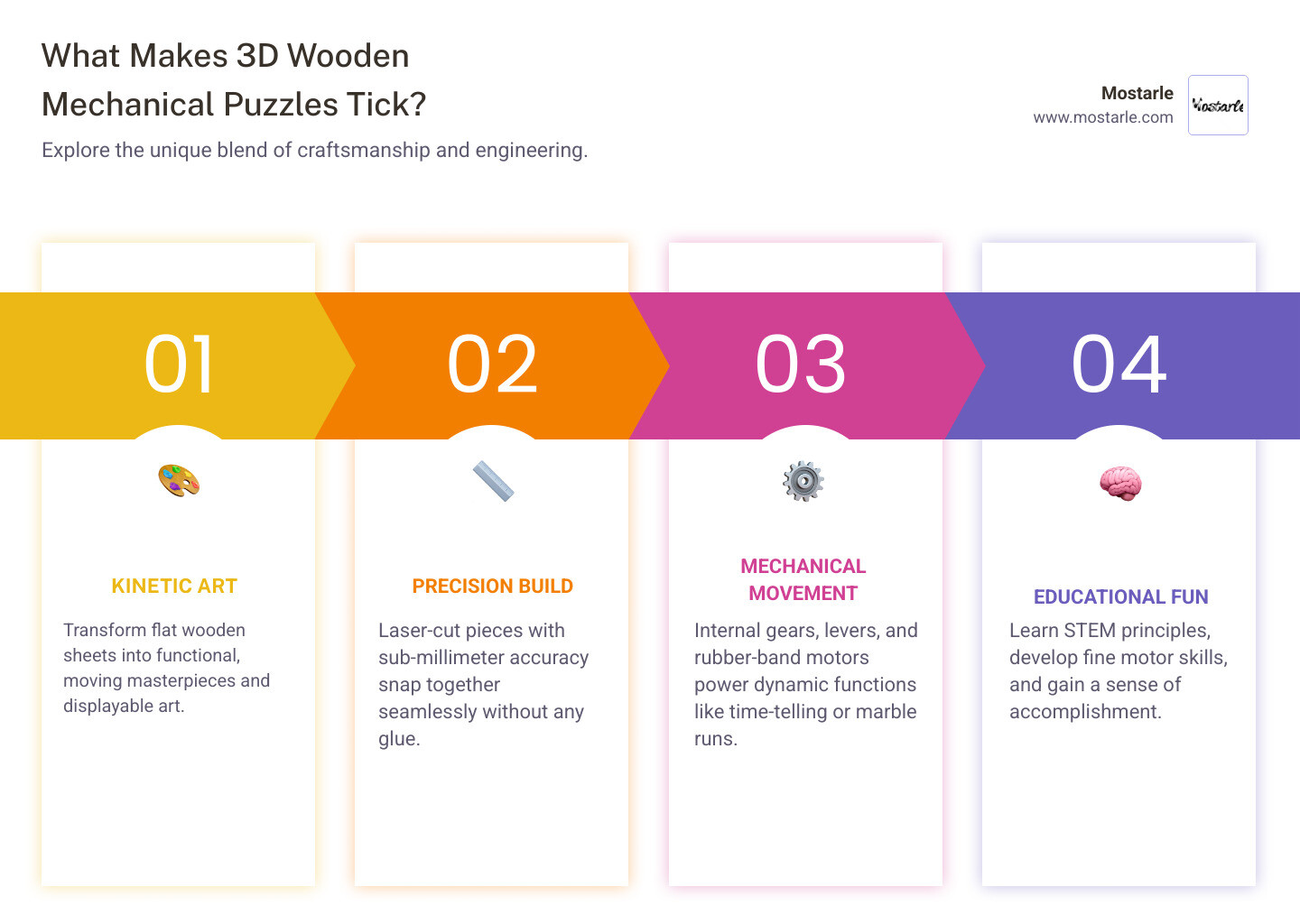
What Makes These Puzzles Tick? A Look Inside
What sets them apart from traditional puzzles:
- They build up into three-dimensional, functional objects instead of flat images.
- Internal mechanisms make them move—no batteries required.
- Eco-friendly laser-cut plywood ensures crisp detail and tight joins, typically within 0.05mm precision.
- Most kits snap together without glue; wax or light lubrication may be recommended to smooth gear movement.
How they work:
- Gears multiply or reduce rotational speed and torque.
- Levers and linkages convert motion from one direction to another.
- Springs and rubber-band motors store potential energy, then release it to power gears, pendulums, and flywheels.
- Gravity adds drama in marble runs and escapements.
Want a primer on gear trains and linkages? We dive deeper in our guide to gears in wooden puzzles.
The Mechanics of a 3D Wooden Mechanical Puzzle
Think of each model as kinetic art with a STEM backbone. Building teaches hands-on principles:
- Geneva drives create intermittent, precise motion steps—great for indexing displays.
- Pendulums regulate movement with a steady beat—ideal for clocks.
- Tourbillons expose the elegance of rotating escapements—visually stunning, historically used to counter gravity in watches.
Many brands offer mechanism-focused kits that let you explore these principles up close.
Prefer to shop by gear models on our site? Explore gear models.
More Than a Hobby: The Cognitive and Developmental Benefits
These projects are as brainy as they are beautiful:
- Problem-solving: Following complex instructions and troubleshooting tight tolerances builds grit and logic.
- Spatial reasoning: Visualizing how flat parts form 3D assemblies sharpens mental rotation skills.
- Fine motor skills: Precision pressing, aligning tabs, and careful sanding hone dexterity.
- Focus and patience: Multi-hour builds encourage a healthy, meditative flow state.
- STEM learning: See physics and engineering in action—gears, energy storage, friction, and kinematics.
History also shows their broad appeal. From 18th-century educational tools to their surge in the 1930s, wooden puzzles have long captured adult attention. Modern sets layer education with sophisticated mechanics—some with self-propelled rubber-band motors and classic mechanisms like the Geneva drive and pendulum.
Curious how wood stacks up to metal? See our candid comparison: 3D wooden vs 3D metal puzzles.
Exploring the Universe of 3D Wooden Mechanical Puzzles
Popular themes we love:
- Vehicles and engines
- Clocks and timekeepers
- Music boxes and instruments
- Marble runs and kinetic sculptures
- Steampunk contraptions and secret boxes
- Book nooks and decorative dioramas
- Novelty models like wooden guns and mini desk toys
Many online stores allow you to explore specialty subcategories and filter by difficulty, piece count, and type.
Functional Art: Clocks and Secret Boxes
Clocks are the crown jewels of 3d wooden mechanical kits. Two popular types stand out:
- Tourbillon Table Clocks: These advanced models, often with over 300 parts, can take 9–16 hours to build. Powered by a spring, some can tick for hours per wind. Instead of hands, time might be displayed on rotating reels, with the tourbillon mechanism as a mesmerizing focal point.
- Steampunk Clocks: These are functional, artistic timepieces with exposed gears, typically requiring 6–8 hours to build and recommended for ages 14+.
If you prefer models that hide secrets:
- Mechanical Treasure Boxes: With around 190 parts, these puzzles take 4–8 hours to assemble. Turning a key, spinning a gear, or pressing a lever can open up the lid via a hidden internal mechanism, creating a clever mix of storage and showpiece.
Browse clocks on our site:
- See a Steampunk Clock model
- Find a Tourbillon Clock
- Reviews and picks: Clockwork wonders: mechanical wooden puzzle clocks reviewed
Kinetic Wonders: Vehicles and Marble Runs
Vehicles and engines bring powertrains into your living room:
- V8 Engine models, with around 776 parts, showcase crankshafts, pistons, and timing—pure mechanical poetry you can build.
- Endurance racing fans will appreciate high-piece-count racers that push 900+ parts.
Marble runs are gravity-powered eye candy:
- Expect chain hoists, spiral drops, and splitters that reroute marbles in seemingly impossible ways.
- Many gear-driven designs emphasize rotation and power transmission across shafts, combining aesthetics with engineering depth.
See mechanism-focused collections:
- Check out mechanical mechanisms
How to Choose Your Perfect Wooden Puzzle
Choosing your first (or next) kit comes down to three things: difficulty, theme, and features. Most catalogs let you filter by price, piece count, age, or type. You’ll find everything from entry-level kits under 100 pieces to showstoppers with 300+ parts.
A typical catalog snapshot:
- 127–250+ models across themes like clocks, vehicles, guns, book nooks, and marble runs
- Difficulty filters often labeled Easy, Medium, Hard
- Piece-count bands: under 100; 100–149; 150–199; 200–299; 300+
- Age recommendations commonly range from 8+ (with adult help) to 14+ and 18+
Here’s a quick guide to matching difficulty with time and piece counts.
| Difficulty | Typical Piece Count | Estimated Assembly Time |
|---|---|---|
| Easy | Less than 100 | 1–3 hours |
| Medium | 100–300 | 4–8 hours |
| Hard | More than 300 | 9–16+ hours |
Finding the Right Challenge for Your Skill Level
- If you’re new, start small. A 100–150 piece music box or vehicle is perfect. Many “easy” builds fall under 100 pieces and can be finished in a single sitting.
- Ready for more? Mid-range builds (200–300 parts) offer satisfying complexity without being overwhelming.
- Love a challenge? Advanced sets run 300+ parts, often into the 700–1,200 range. Examples include V8 engines (around 776 parts) and large, intricate models with over 1,200 pieces.
- Age guidance: Most kits recommend 14+ due to small parts and precision steps. Younger builders (8–13) can enjoy the process with adult supervision—it’s a fantastic family project.
Choosing Your First 3D Wooden Mechanical Model
Consider:
- Theme: Clocks, marble runs, vehicles, secret boxes, music boxes, or book nooks.
- Functionality: Do you want motion you can wind? Timekeeping? A playable music mechanism?
- Display size: Check assembled dimensions to ensure shelf fit.
- Piece count and time: Match your schedule and patience level.
What’s typically in the box:
- Pre-cut plywood sheets with labeled sprues
- Step-by-step illustrated manual
- Sometimes LEDs or electronic bits (for select models)
- Small helper tools (e.g., tweezers), though not always
Good to know:
- Glue and wax are often not included due to shipping rules, and generally not required thanks to tight tolerances (about 0.05mm). That said, a little wax can help gears run smoothly.
- Part replacement support: If something is missing or breaks, we typically help with replacements.
- Care: Keep models in a cool, dry place. Consider a dust cover once displayed.
New here? Start with our picks and tips in Beyond flat: discover the best 3D wooden puzzles.
Curious how an unboxing/build feels? Peek behind the scenes in our hands-on journal:
Frequently Asked Questions about 3D Wooden Mechanical Puzzles
Do I need glue or special tools to assemble it?
No. Most kits are laser-cut with high precision (about 0.05mm tolerance) and press-fit together. Some include small helper tools. Glue and wax are typically not included due to shipping rules, and glue is not required.
What if a piece is missing or breaks during assembly?
We’ve got you. Mostarle offers responsive support and can arrange spare part replacements. Reach out through our site with your kit name and part number.
What age group are these puzzles suitable for?
Generally 14+ because of small parts and detailed steps. With adult help, builders 8–13 can enjoy many kits. It’s an excellent family activity.
How long will my model run?
It varies. For example, some complex clock models can tick for up to 3 hours per wind. Music boxes and vehicles depend on the rubber-band or spring energy you wind.
How hard are they, really?
Difficulty correlates with piece count and mechanism complexity. Many “hard” models exceed 300 parts and may take 9–16 hours or more. Choose based on your patience level and experience.
What materials are used?
Eco-friendly, laser-cut plywood is standard. Some kits include metal axles, string, or LEDs where needed, but the core structure is wood.
Are they educational?
Absolutely. Expect hands-on lessons in basic physics, mechanics, and engineering—gears, linkages, energy storage, and motion control. They’re used by hobbyists, educators, and lifelong learners.
Can I display the finished model?
Yes—please do! These are designed to be display-ready. Keep them in a cool, dry space. A dust cover helps preserve motion and finish.
What are good starter themes?
Music boxes and small vehicles are great first builds. For a more ambitious first project, try a medium-difficulty clock or a compact marble run.
Where can I learn more about specific mechanisms?
We break down mechanical concepts in Beyond the pieces: a guide to mechanical gears. Many brands also offer kits that focus specifically on showcasing individual mechanisms.
Conclusion: Your Journey into Mechanical Craftsmanship
From a stack of laser-cut sheets to a ticking clock or a flowing marble run, 3d wooden mechanical puzzles deliver more than a build—they deliver a moment of wow every time your model moves. That blend of focus, curiosity, and visible physics is why we love them.
At Mostarle, we believe creativity has no limits—whether we’re turning forgotten nuts and bolts into art or curating wooden mechanisms that bring motion to life. If you’re ready to start, we’re here with tips, support, and plenty of kits for every level.
Explore our deep-dive on picking and building the right model:
Explore everything you need to know about mechanical puzzles