
From Jigsaw to 3D: Unraveling the Magic of Wooden Puzzles
Why Wooden Puzzles Captivate Minds Across Generations

A wood puzzle is a brain teaser or assembly challenge made from wooden pieces that you fit together to create shapes, images, or functional models. Unlike cardboard puzzles, wooden puzzles offer a tactile, lasting experience that ranges from traditional jigsaw designs to intricate 3D mechanical structures with moving parts.
Types of Wood Puzzles:
- Classic Jigsaw Puzzles - Flat puzzles with artistic designs cut from wood
- 3D Wooden Models - Build-up kits that create functional objects like music boxes or clocks
- Mechanical Puzzles - Gear-driven models with moving parts and interactive features
- Packing Problems - Brain teasers where you fit wooden pieces into a confined space
- Logic Puzzles - Challenges like the log stacker that require spatial reasoning to solve
Last week, a mysterious double-sided puzzle appeared at Khan Academy's office. Five team members immediately began writing computer programs to solve it. After days of work and countless algorithms, they found the hard side was intentionally unsolvable—a reminder that wooden puzzles have been stumping and delighting humans for generations.
Wooden puzzles offer something screens cannot replicate: the weight of real wood in your hands, the satisfying click of laser-cut pieces snapping into place, the quiet pride of watching gears turn on a model you built yourself. They bridge the gap between art and engineering, between patience and accomplishment.
With over 100 million downloads of digital wood puzzle games and the wide variety of physical 3D wooden puzzle products available today, it's clear this ancient craft has found new life. From simple 80-piece jigsaws to complex 1000-piece mechanical marvels, wooden puzzles challenge everyone from 8-year-olds to adults seeking creative escape.
The beauty lies in their versatility. Some people frame finished jigsaws as art. Others display functional 3D models—cuckoo clocks, marble runs, book nooks—as conversation pieces. The eco-friendly, non-toxic wood and precision laser-cutting (within 0.05mm) transform what could be a disposable hobby into heirloom-quality pieces.
Whether you're drawn to the neat simplicity of a classic jigsaw or the mechanical complexity of a gear-driven 3D model, wooden puzzles offer a tangible way to express creativity and stand out from the digital noise.
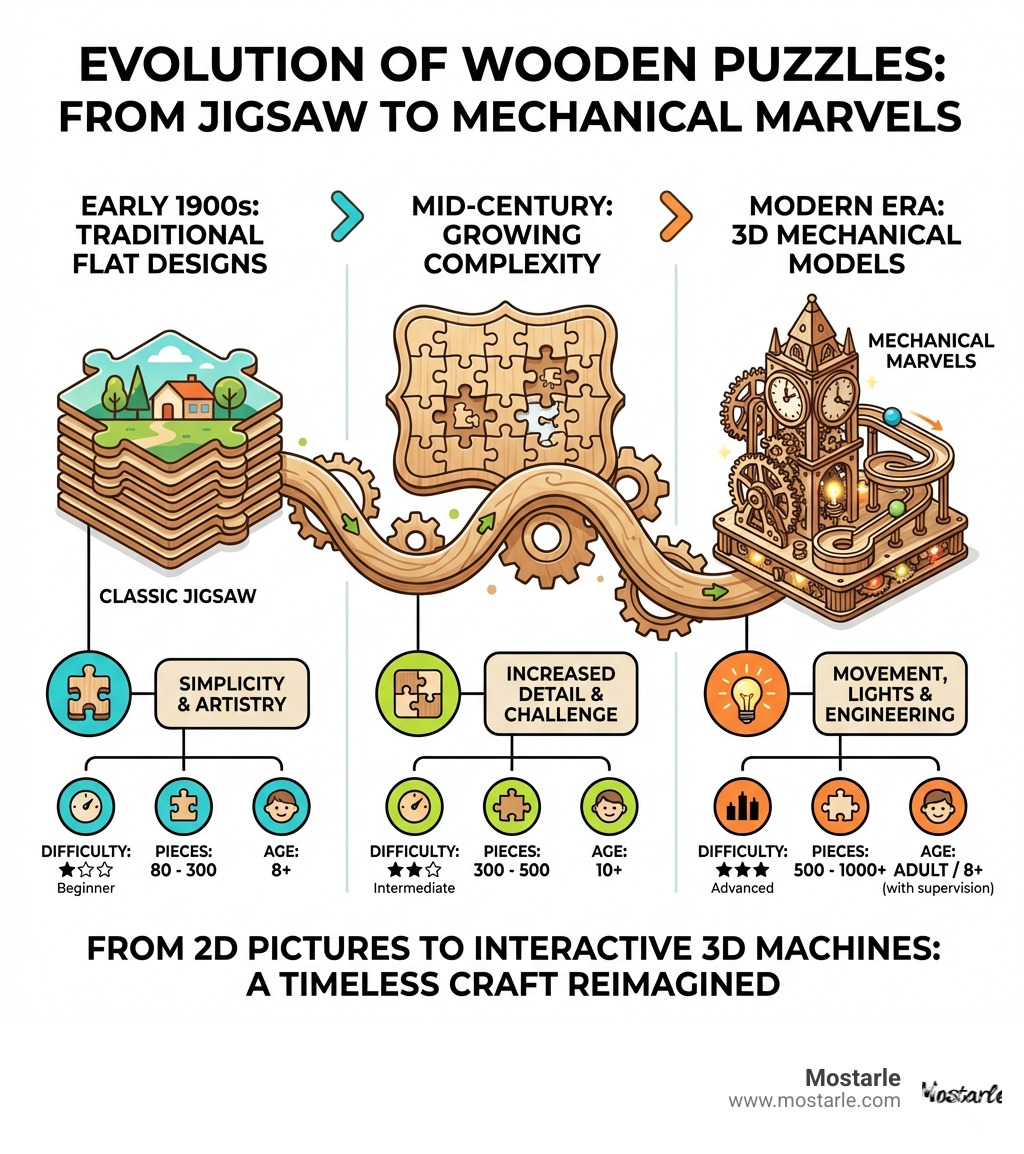
Find more about wood puzzle:
The Evolution and History of the Wood Puzzle
The wood puzzle isn't just a modern toy; it’s a craft steeped in history. The very first jigsaw puzzles, created in the 1760s by European cartographers like John Spilsbury, were actually made of wood. These "dissected maps" were used as educational tools to teach geography to the children of the elite. Since then, the craftsmanship has evolved from hand-sawed mahogany planks to high-tech laser-cut plywood.
Historically, wooden puzzles represented a significant cultural shift in how we approach leisure. In the early 20th century, puzzles were often the centerpiece of social gatherings. They weren't just about the image; they were about the tactile experience of handling high-quality wood. This cultural context remains relevant today in countries ranging from the United Kingdom to Japan and the United States, where the tradition of gifting a high-quality wood puzzle signifies a deep appreciation for the recipient's intellect and patience.
The evolution of spatial reasoning is perhaps the most fascinating part of this history. We’ve moved from 2D maps to "packing problems"—puzzles like the Logs Puzzle, a classic wooden packing problem where the challenge is to fit cylindrical pieces into a frame. This transition mirrors our growing understanding of geometry and logic. Today, pioneers in the industry use laser technology to achieve a precision of 0.05mm, allowing for the creation of mechanical gears that actually function without a drop of glue.
Exploring Different Types of Wooden Puzzles
When we talk about a wood puzzle, we are describing a massive spectrum of creativity. At Mostarle, we believe that ordinary materials can become extraordinary art, and wooden puzzles are the perfect example of this philosophy.
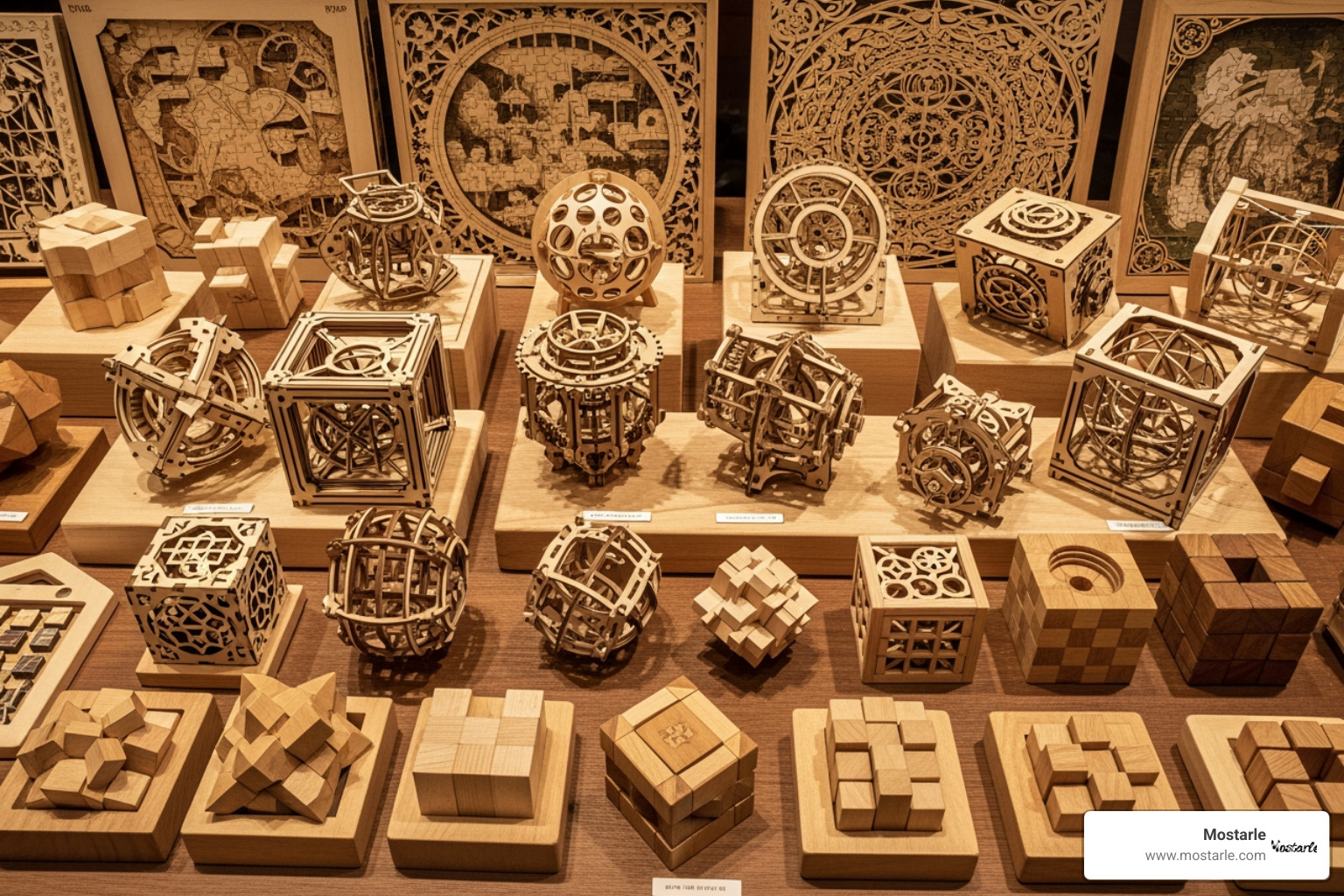
Classic Jigsaw Wood Puzzle Designs
The classic wood puzzle remains a favorite for its artistic themes and unique prints. Unlike cardboard, wooden jigsaw pieces are often "whimsy" pieces—cut into recognizable shapes like birds, flowers, or even landmarks.
We see modern designers pushing the boundaries of visual thinking. For instance, premium wood puzzles feature intricate patterns that challenge even seasoned puzzlers. These aren't just games; they are logic challenges that require you to look beyond the colors and focus on the grain and fit of the wood. Many of these puzzles are inspired by natural phenomena, adding a layer of storytelling to the assembly process.
Modern 3D Wood Puzzle and Mechanical Kits
The real magic happens when we move into the third dimension. Wooden Model Kits have revolutionized the hobby. These are not static models; they are engineering feats.
By following a Guide to Mechanical Gears in Wooden Puzzles, builders can create functional cuckoo clocks, marble runs, and even music boxes. The use of eco-friendly, non-toxic wood ensures that these projects are safe for the whole family. These kits often feature:
- Laser-cut precision: Ensuring every gear tooth meshes perfectly.
- Functional Play: Models that move, light up, or play music.
- Complexity: Ranging from "Easy" (under 100 pieces) to "Hard" (over 300 pieces).
| Feature | 2D Jigsaw Wood Puzzle | 3D Mechanical Wood Puzzle |
|---|---|---|
| Primary Goal | Complete an image | Build a functional model |
| Skill Focus | Visual recognition | Spatial reasoning & mechanics |
| Piece Count | 80 to 1000+ | 50 to 400+ |
| Tools Needed | None | Sometimes tweezers or sandpaper |
| Display Value | Wall art | Desk decor / Interactive toy |
The Rewards of Solving and Assembling Wood Puzzles
Solving a wood puzzle is more than just a way to pass the time; it is a full-brain workout. Whether you are dealing with a digital version like Woodoku (with its 100 million downloads) or a physical block puzzle, the rewards are both cognitive and emotional.
For seniors, wooden puzzles are an incredible tool for maintaining fine motor skills and cognitive health. The tactile nature of wood provides sensory feedback that cardboard simply can't match. For younger age groups, specifically the 8 to 14 range, puzzles like the Log Stacker or the 27 Smart Cubes (inspired by Boris Nikitin's "Unicube") help train 3D spatial perception and logical thinking.
The rewards often come through overcoming significant challenges. Take the "Red Wood Block Packing Problem," which is rated as a Level 4 difficulty. It requires a mathematical approach to fit 9 pieces into a space that seemingly only fits 8. The "Aha!" moment when that final piece slides in is a dopamine hit like no other. To find your next challenge, you can Discover the Best 3D Wooden Puzzles custom to your skill level.
Tips for Assembly and Display
Assembling a complex wood puzzle requires patience and the right technique. Here are our top tips:
- Wax the Gears: If you are building a mechanical model, use a bit of candle wax on the gear teeth. This reduces friction and ensures smooth movement.
- Use the Right Tools: While most kits don't require glue, having wood clamps and a bit of sandpaper on hand can help with stubborn pieces.
- Finishing Touches: A light walnut stain can give your finished piece a vintage, professional look.
- Lighting and Protection: Many 3D models now come with LED lighting kits. Once finished, consider a dust cover to protect the intricate gears.
For those interested in functional timepieces, we've seen many Mechanical Wooden Puzzle Clocks Reviewed that highlight the importance of precise assembly for timekeeping accuracy.
Conclusion
At Mostarle, we believe that creativity has no limits. Just as we transform nuts, bolts, and forgotten hardware fragments into remarkable art, a wood puzzle transforms a simple piece of timber into a complex, engaging world. Whether it’s a 1000-piece artistic jigsaw or a gear-driven mechanical marvel, these puzzles prove that the journey of creation is just as rewarding as the finished masterpiece.
We invite you to step away from the screen and experience the tactile magic of wood. From the historical roots of map-making to the future of 3D engineering, the wooden puzzle remains a timeless testament to human ingenuity. For a deeper dive into this world, check out Everything to know about mechanical puzzles.
Frequently Asked Questions about Wood Puzzles
Do I need glue for 3D wooden puzzles?
Most modern 3D wooden puzzles are designed with laser-cut precision (within 0.05mm), allowing the pieces to fit snugly together using friction. In most cases, you do not need glue. However, for some structural components or if a piece accidentally breaks, a small amount of wood glue can be helpful.
What is the hardest type of wood puzzle to solve?
"Packing Problems" and high-difficulty mechanical models are often considered the hardest. Puzzles like the Log Stacker or the Red Wood Block Packing Problem are notorious for having very few solutions (sometimes only one or two) despite having many pieces that look like they should fit.
Are wooden puzzles better than cardboard ones?
"Better" depends on your goal, but wooden puzzles are certainly more durable and offer a better tactile experience. They don't bend or peel like cardboard, and the unique "whimsy" shapes found in wooden jigsaws add a layer of challenge and artistry that standard cardboard pieces lack. Plus, they are often made from eco-friendly, sustainable materials.
What age is appropriate for a 3D wood puzzle?
While simple wooden peg puzzles are great for toddlers, 3D mechanical kits are generally recommended for ages 14 and up. However, children as young as 8 can often complete them with adult supervision, making them an excellent bonding activity.
How do I maintain my wooden puzzle?
Keep your wood puzzle in a cool, dry place to prevent the wood from warping. For mechanical puzzles, occasionally check the gears for dust and re-apply a small amount of wax if the movement becomes stiff. Avoid direct sunlight, which can fade the artistic prints or stains.